

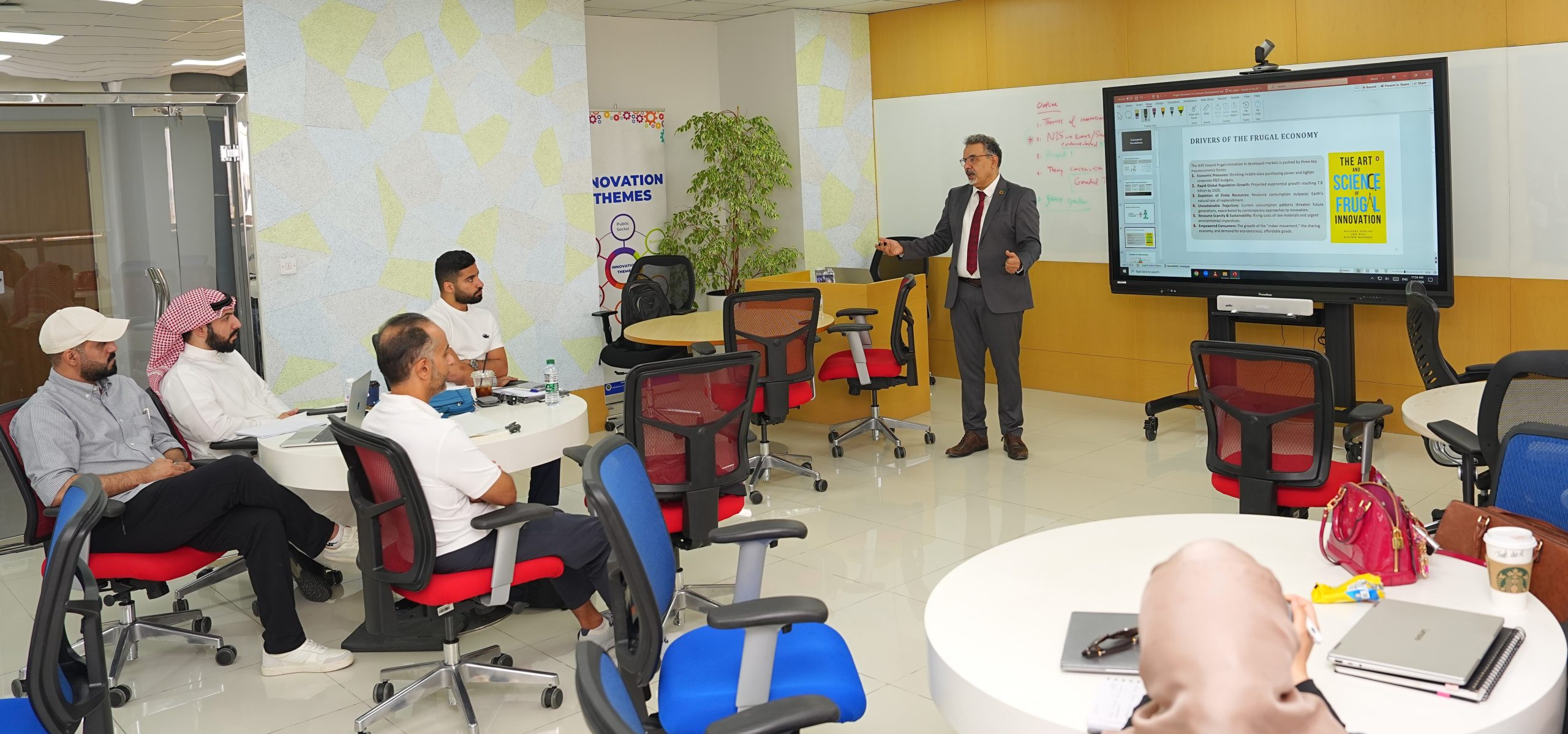
The Innovation and Technology Management Program at the College of Education, Administrative and Technical Sciences at Arabian Gulf University, hosted Dr. Atef Al-Shabrawy, Professor of Innovation and Entrepreneurship at the Egyptian-Japanese University of Science and Technology (E-JUST), to deliver a specialized lecture on “Social Innovation and Entrepreneurship”. He reviewed global models of using innovation to serve sustainable development goals, highlighting practical solutions for establishing social innovation labs and innovative policy labs, as well as the importance of adopting user-centered and open innovation methodologies to develop solutions that address the needs of local communities.
The lecture also addressed the concept of frugal innovation and its role in addressing resource constraints and economic and environmental challenges by developing simple, cost-effective, and efficient solutions that create added value and maximize the use of locally available resources and capabilities.
Dr. Al-Shabrawy reviewed a number of global business models in the field of innovation for sustainable development, explaining how to transform societal challenges into opportunities for innovation, with a focus on building participatory systems that enable beneficiaries and community members to contribute to identifying problems, design, test, and develop solutions tailored to their actual needs. He also discussed—in the presence of doctoral students in innovation management — practical applications of smart innovation in the health and creative industries sectors in several Asian and African countries, illustrating how low-cost solutions, designed according to user needs, have helped address local challenges and deliver innovative services and products in resource-constrained environments.
Dr Al-Shabrawy emphasized the importance of social innovation labs and innovative policy labs as platforms for testing new ideas, policies, and solutions, noting that the success of innovation is not linked to the size of resources, but rather to the ability of institutions to optimize their use and maximize the value derived from them.
He explained that smart innovation is based on simplicity, efficiency, resource conservation, and sustainability, making it well-suited to addressing economic challenges and limited capabilities.
He noted that this approach can help address poverty and unemployment by developing locally based solutions that meet local needs and creating innovative business models that draw on local potential, while maximizing the use of human resources. He emphasized the importance of user-centered innovation and open innovation in achieving sustainable development, as they enable the utilization of knowledge and enhance the participation of beneficiaries and partners in developing appropriate and applicable solutions.
The lecture concluded by emphasizing the importance of shifting from viewing innovation as an activity linked to technology and the availability of substantial resources to viewing it as a practical methodology for finding flexible and sustainable solutions that stem from the needs of society and efficiently utilize available resources to achieve tangible economic, social, and environmental impact.
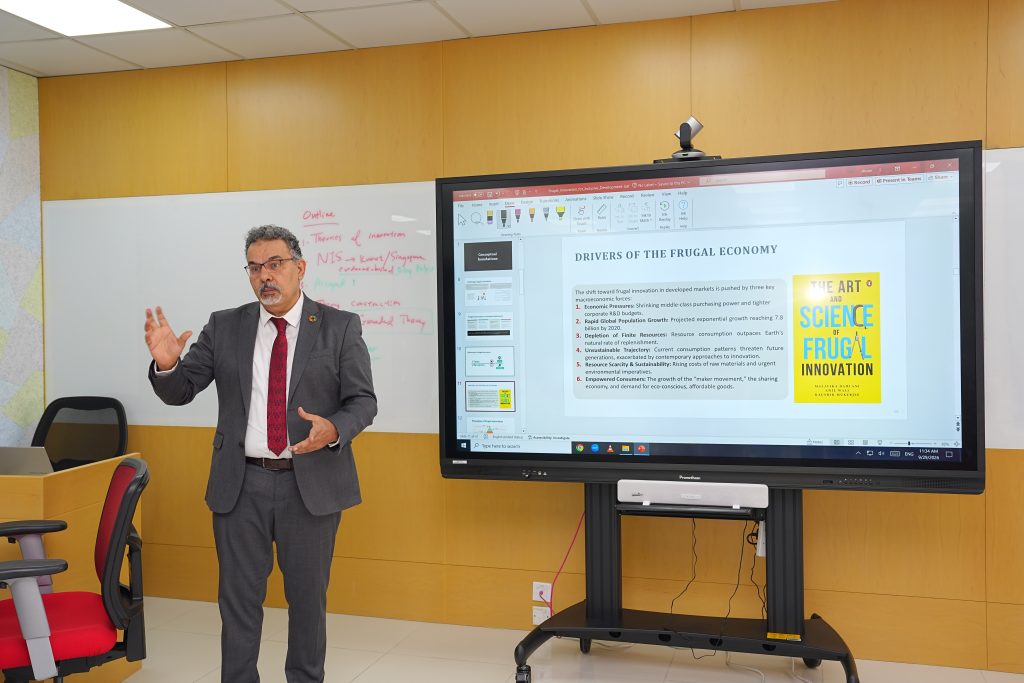
This lecture is part of the activities of the Ph.D. program in Innovation Management at Arab Gulf University, which was established in 2016. It has provided various sectors across the Gulf Cooperation Council (GCC) countries with professionals specialized in innovation management and has contributed to the graduation of more than 60 students from diverse disciplines and sectors, reflecting its role in building research and leadership capacities capable of keeping pace with the rapid transformations in work environments and development.
The university’s introduction of the Innovation Management major and the development of its academic programs reflect a proactive vision to address emerging issues and the needs of Gulf and Arab societies by preparing professionals capable of anticipating challenges and transforming them into opportunities, and developing innovative solutions grounded in scientific research that serve sustainable development, thereby strengthening the university’s contribution to building ecosystems of innovation and entrepreneurship and addressing evolving development issues in the region.