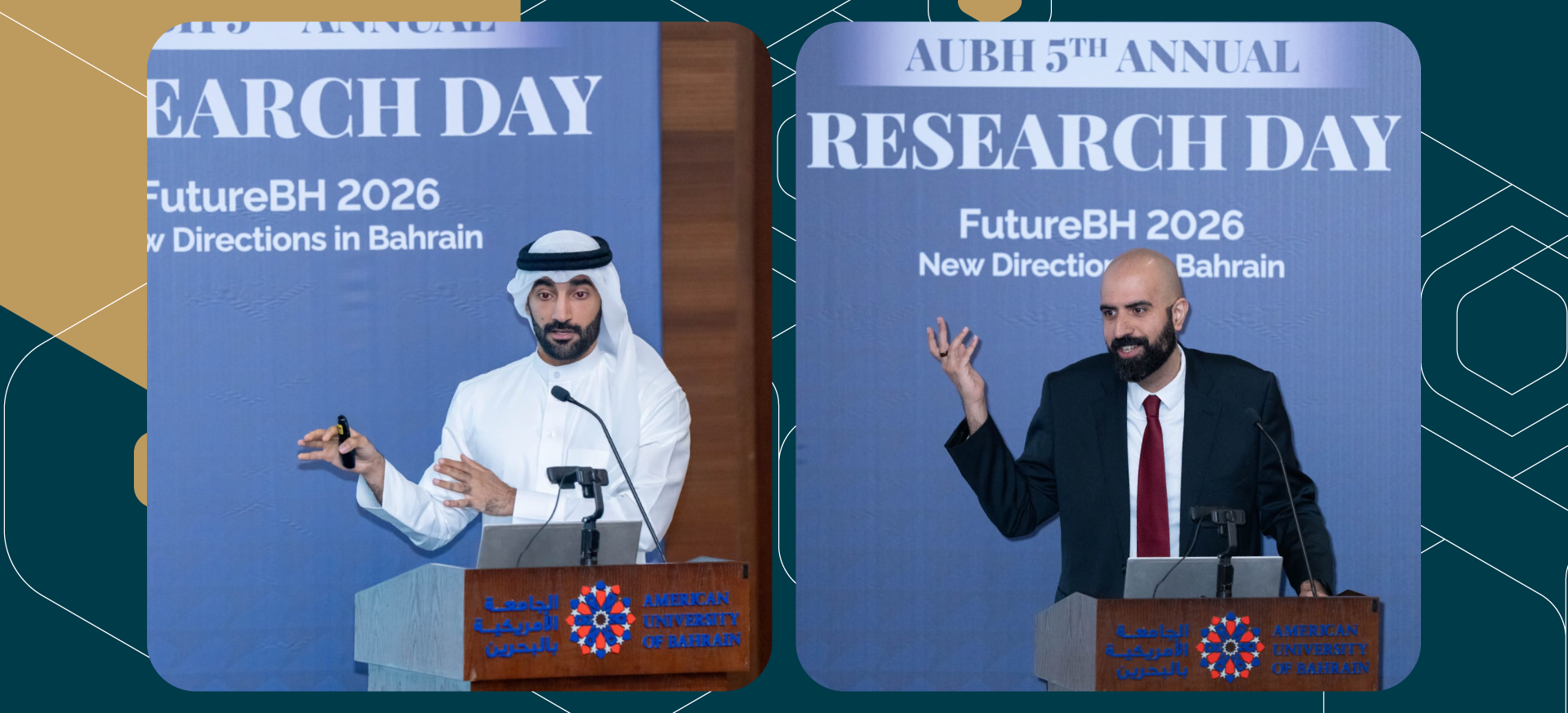
Two Academics from Arabian Gulf University Participate in the Annual Scientific Research Day at the American University of Bahrain
Arabian Gulf University
13 Jul, 2026
Two academics from the College of Education, Administrative and Technical Sciences at Arabian Gulf University participated in the events of the Fifth Annual Scientific Research Day, organized by the American University of Bahrain (AUBH) under the theme “Bahrain Vision 2026: New Directions in Bahrain,” with broad participation from academics, researchers, and experts from various higher education institutions and government agencies.
Dr. Manaf Al-Khuzaei and Dr. Yousif Al-Nawakhtha, both academics at Arabian Gulf University, delivered two academic lectures addressing the latest trends in the fields of technology and digital transformation, as part of efforts to strengthen academic cooperation and the exchange of research expertise among higher education institutions in the Kingdom of Bahrain. Dr. Al-Khuzaei delivered a lecture titled “Ask the Map: How Artificial Intelligence and Geospatial AI Can Drive Bahrain’s Future,” in which he reviewed applications of geospatial AI in supporting planning and sustainable development. Meanwhile, Dr. Al-Nawakhtha presented a research paper on “Securing Bahrain’s Digital Future: The Transition to Quantum-Resistant Encryption,” in which he emphasized the importance of preparing for future challenges in the field of cybersecurity.
Dr. Al-Khuzaei, a researcher in artificial intelligence applications, modeling, and programming languages, emphasized that artificial intelligence—particularly geographic artificial intelligence (GeoAI)— is bringing about a radical transformation in the way spatial data is analyzed and decisions are made. He explained that modern technologies now allow users to ask questions in natural language on maps and receive accurate answers within seconds—tasks that previously required specialized expertise, complex software, and a significant amount of time.
He said: “Artificial intelligence is not intended to replace humans, but to empower them. It handles repetitive tasks and saves time and effort, while the human role remains essential in understanding problems and making decisions. When AI works alongside experts, the results become more accurate and impactful.”
He noted that the real opportunity lies in developing AI models tailored specifically for Bahrain and the Gulf states, based on regional data and taking into account the region’s climatic and geographical characteristics, which makes them more efficient than generic models developed for different environments. He added: “Bahrain has a significant competitive advantage due to its small size and the ease of implementing smart solutions nationwide, which gives it a real opportunity to serve as a leading model in the use of geospatial artificial intelligence to advance sustainable development.”
Al-Khuzaei explained that the practical applications of these technologies have become a tangible reality, showcasing a model of a smart geographic assistant developed for Bahrain, which has successfully mapped the highest temperature areas, monitored changes in vegetation cover, identified roads at risk of flooding, and extracted buildings from satellite imagery. He concluded his remarks by emphasizing that the tools and technologies are more accessible today than ever before, and that future leadership in this field depends on investing in the development of national solutions led by the people of Bahrain. He said: “The tools are in our hands, and the opportunity is available today. If we take the initiative to build our own solutions, Bahrain can be at the forefront of countries that utilize artificial intelligence to serve society and promote development.”
For his part, Dr. Yousif Al-Nawakhtha, Assistant Professor of Quantum Computing and Cryptography in the Department of Computing at the College of Education, Administrative and Technical Sciences at Arabian Gulf University, emphasized that preparing for the era of quantum computing requires an immediate start in adopting quantum-resistant cryptography, emphasizing that protecting the Kingdom of Bahrain’s digital infrastructure requires early planning and a systematic transition to security solutions capable of addressing future challenges.
He said, “Quantum computing represents a major scientific breakthrough, but at the same time, it poses an unprecedented challenge to the traditional encryption systems on which most digital services rely today. This highlights the importance of quantum-resistant encryption as a practical solution capable of protecting data using current conventional hardware.”
He added that one of the most significant threats is “collect now, decrypt later” attacks, in which adversaries collect and store encrypted data today in anticipation of future quantum computers capable of decrypting it—a threat to data that must remain confidential for extended periods, such as medical records and government data. He noted that the transition to quantum-resistant encryption is not a process that can be carried out quickly, but rather requires planning and investment in time, resources, and expertise. He said: “Starting early reduces security risks and gives organizations sufficient time to carry out a secure and well-planned transition, whereas delaying or rushing implementation may lead to new security vulnerabilities.”
He concluded by emphasizing that investing in information security today is an investment in Bahrain’s digital future, calling on institutions to prepare now to ensure continued trust in digital services and the protection of national data in the face of the challenges of the quantum computing era.
During the event, participants discussed the future of innovation, digital transformation, and smart technologies, as well as their implications for various economic and industrial sectors in the Kingdom. The participation of faculty members from the College of Education, Administrative and Technical Sciences in this scientific event reflects the college’s commitment to supporting scientific research, strengthening its presence in academic forums, and contributing to the discussion of research issues related to national development, in line with the Kingdom of Bahrain’s vision for a knowledge-based and innovative economy.