

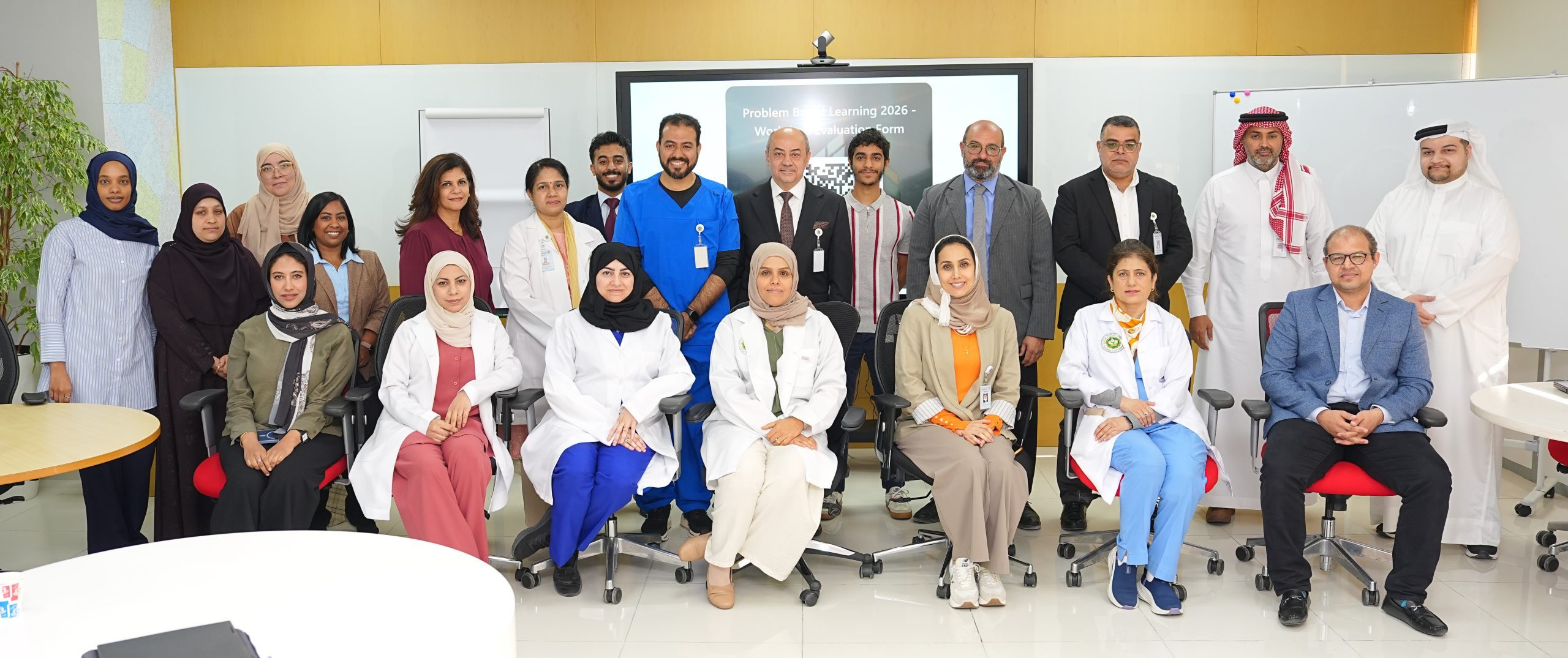
The Department of Medical Education at the College of Medicine and Health Sciences at Arabian Gulf University organized a workshop titled “Problem-Based Learning: Facilitation and Assessment,” as part of the college’s faculty development program, with the aim of enhancing the academic staff’s ability to employ active learning strategies and develop skills in facilitating student learning and assessing their performance in a medical education setting.
Dr. Mohamed Mustafa Al-Iraqi, Head of the Department of Medical Education, opened the workshop, emphasizing the importance of problem-based learning as one of the active learning strategies that enables students to address problems and scenarios that simulate real-world clinical and community settings, thereby contributing to the development of critical thinking, analytical, and problem-solving skills, as well as linking theoretical knowledge to medical practice.
The workshop aimed to enable participants to develop skills in facilitating the students’ learning process, as well as to enhance their ability to evaluate their performance and provide effective feedback within the framework of a problem-based learning strategy, thereby supporting the quality of the educational process and enhancing the learning experience for medical students.
Members of the Department of Medical Education participated in planning the workshop and leading its sessions. Professor Hani Salem Atwah provided an explanation of the concept of problem-based learning, its foundations, and the principles of its application, while Dr. Arshana Prabhu Kumar discussed the criteria and methods for assessing students within this strategy. Dr. Reem Jassim Al-Ansari also presented a practical model on methods for providing effective feedback to students and its role in supporting their learning and improving their performance.
The workshop also featured Professor Mohamed Hani Shehata, Head of the Department of Family and Community Medicine, who discussed effective communication techniques and methods for providing feedback to enhance the learning process, Dr. Abdullah Ismail Abdullah, Head of the Department of Surgery and Associate Dean for Clinical Affairs, also participated by leading an interactive session with students to simulate a problem-based learning environment and apply facilitation skills in a practical setting.
The workshop was spread over two days; the first day was dedicated to introducing the problem-based learning strategy and discussing skills for facilitating the learning process, while the second day focused on student assessment methods and providing effective feedback, thereby contributing to enhancing learning and evaluating academic performance.
The workshop was attended by approximately 20 faculty members from various specialties, featuring lively interaction and discussions about the challenges that may arise when implementing problem-based learning in medical education, as well as ways to address these challenges and develop teaching practices that align with students’ needs and the requirements of modern medical education.
Participants praised the workshop’s scientific and practical content, emphasizing the importance of the diversity of its sessions and the combination of theoretical and practical aspects, as well as the direct interaction with students and trainees, which provided an opportunity to exchange experiences and teaching practices and to develop faculty members’ skills in applying problem-based learning strategies.