

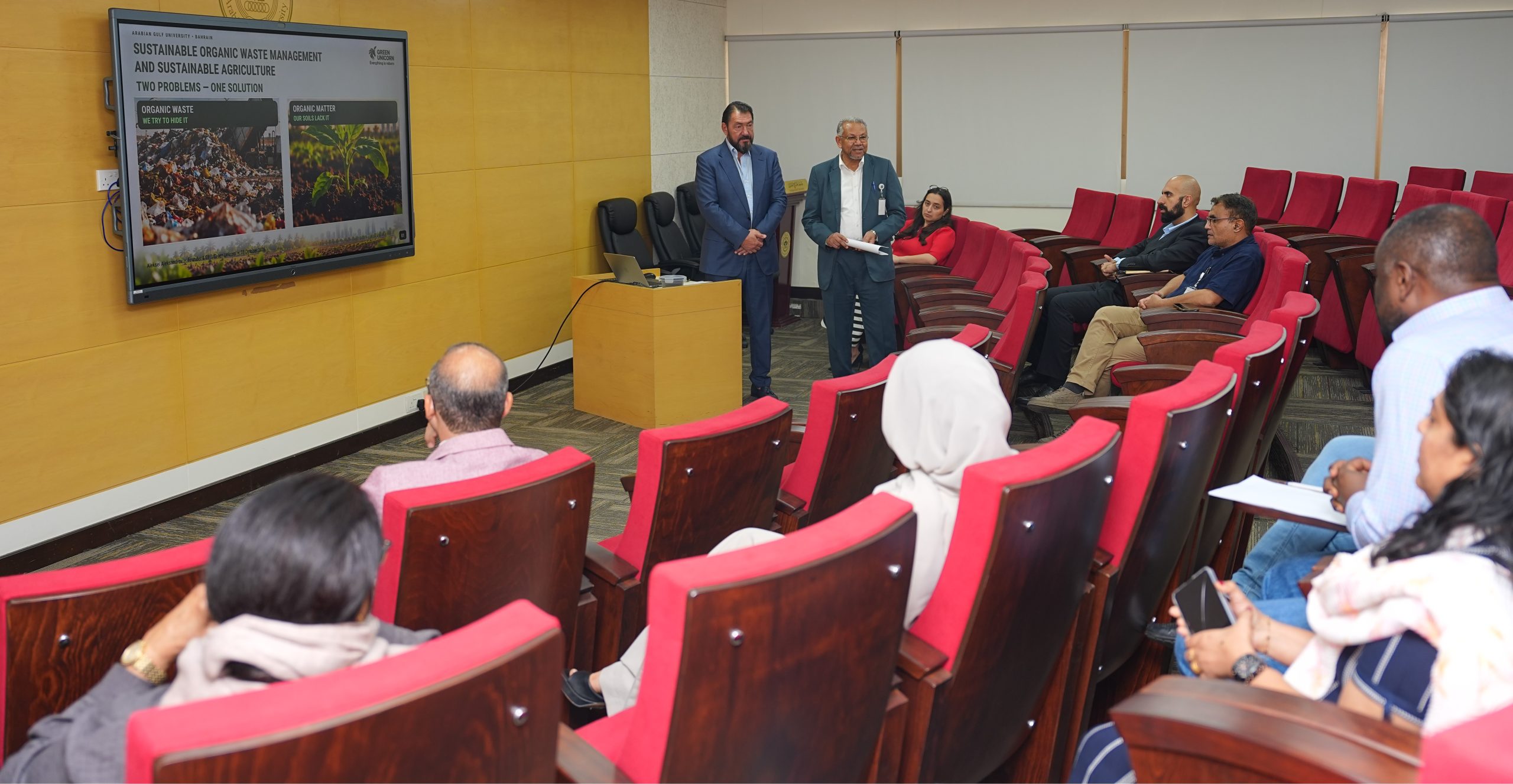
The Center for Environmental and Biological Studies at Arabian Gulf University, as part of the activities of the Sultan Qaboos Chair in Desert Agriculture and the Shaikh Zayed bin Sultan Chair in Environmental Sciences, organized a lecture on the treatment of sewage sludge and its conversion into soil suitable for agriculture. The lecture was presented by Alexandrov, founder and CEO of Green Unicorn in the Kingdom of Bahrain, who shared the company’s experience in this field.
The lecture addressed the economic, environmental, and health dimensions of sludge management in the Gulf Cooperation Council (GCC) countries, in line with the Center’s focus on interdisciplinary research that integrates environmental management, water management, agriculture, food security, and waste management. This approach aims to support the sustainable management of natural resources, contribute to national plans to reduce pollution and emissions, increase green spaces, and enhance food security.
The lecture reviewed the challenges facing countries worldwide—particularly GCC member states—in managing sewage sludge, given population growth and the expansion of wastewater treatment plants. It addressed four methods of sludge management: landfilling, composting, drying, and the “Green Unicorn” technology. According to the presentation, landfilling is low-cost but carries environmental risks, while composting involves moderate costs and environmental risks—the latter associated with the presence of heavy metals. Drying, on the other hand, was described as high-cost and medium-risk. The presentation also addressed complete incineration and the resulting ash rich in heavy metals, as well as carbon dioxide emissions and high energy requirements.
The presenter introduced the “Green Unicorn” technology as a Soviet-origin technique that relies on adding a substance composed of organic amino acids to sludge; this substance can be produced locally from organic waste. He explained that, according to the company’s presentation, the technology aims to eliminate harmful microbes and convert heavy metals into non-toxic compounds, and organic matter into odorless compost that is mixed with sand to produce fertile soil with improved physical and chemical properties. He noted that, according to the presentation, the technology can be implemented at wastewater treatment plants at a moderate cost, without the need for additional infrastructure.
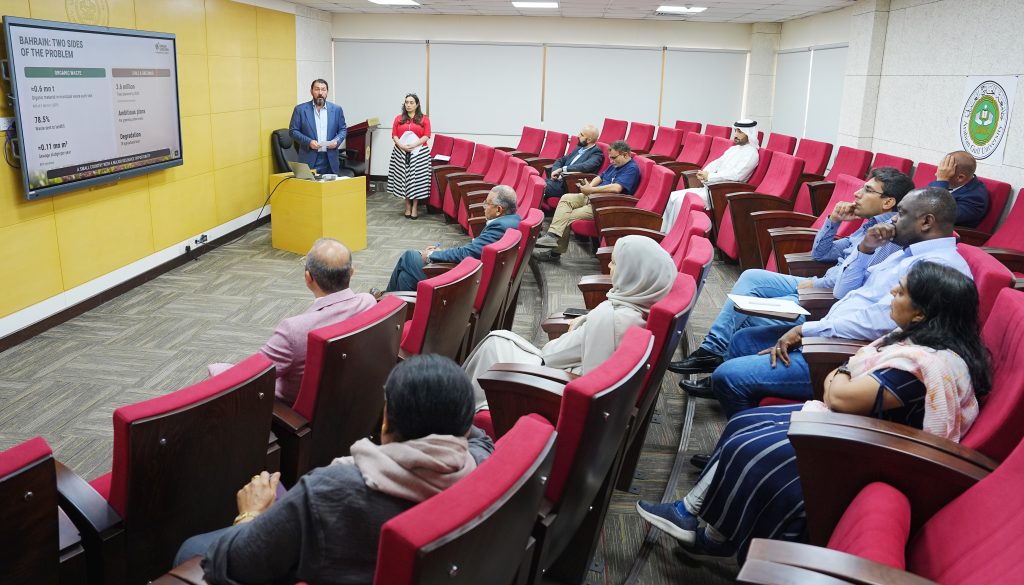
The lecture featured a scientific discussion on the nature of the material used in the treatment, the fate of microorganisms, the impact of climatic conditions, and the stability and fate in the soil of the compounds resulting from the treatment of heavy metals. The discussion also addressed the characteristics of the resulting soil and its organic matter content, as well as its role in improving the texture of sandy soil, increasing its water-holding capacity, and reducing the need for irrigation water.
Participants in the discussion emphasized the need for further independent research to comprehensively evaluate the technology, verify its suitability for the climatic and natural conditions in the Kingdom of Bahrain, and study its effects on soil, crop production, and afforestation.