

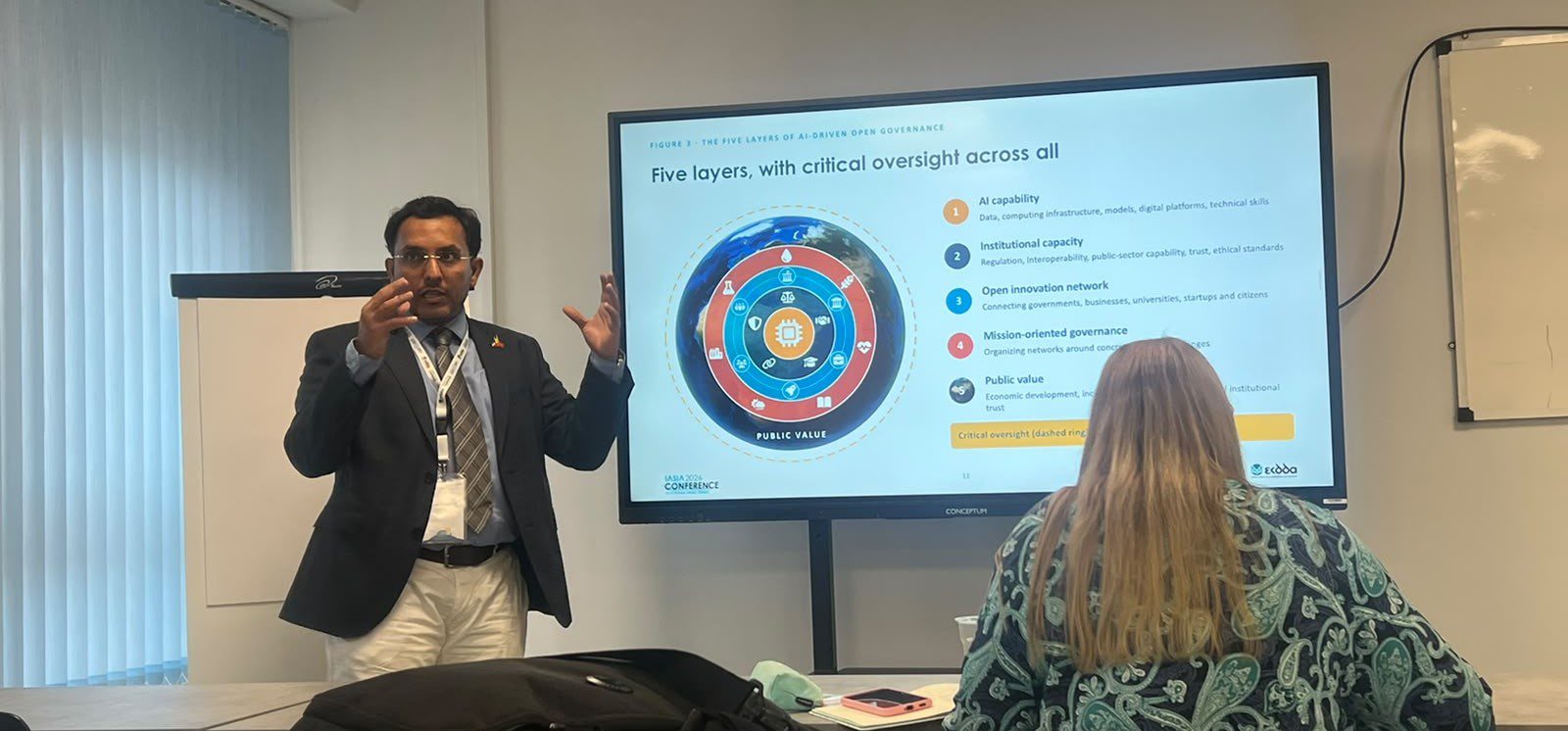
Dr. Meshari Abdulhamid Al-Saffran, a graduate of the Innovation Management program at Arabian Gulf University, presented a peer-reviewed research paper proposing an open network model for artificial intelligence governance in the 57 member states of the Organization of Islamic Cooperation (OIC). This was during his participation in the 2026 Annual Conference of the International Association of Schools and Institutes of Administration (IASIA) in 2026, held in the Greek capital of Athens under the theme “Rethinking Governance for a Changing World,” in collaboration with the National Center for Public Administration and Local Governance in Greece.
Al-Saffran, who works at the Public Authority for Applied Education and Training in the State of Kuwait, prepared the paper in collaboration with Prof. Dr. Ouda Al-Jayousi, Professor of Innovation Policy at Arabian Gulf University in the Kingdom of Bahrain. The paper was titled “Paradigm Shifts in Global Governance: Toward Open Innovation and AI-Based Global Commons” and was presented during the 12th Working Group session, “Artificial Intelligence and Digital Technologies in the Public Sector,” after being selected for the conference program following review by the working group heads.
The study emphasizes that the most profound impact of artificial intelligence on government work goes beyond the technical dimension to bring about institutional transformation. It argues that the role of governments should not be limited to automating existing procedures but can extend to coordinating networks that bring together public institutions, universities, the business sector, startups, and citizens to generate knowledge and create public value.
The paper used the Organization of Islamic Cooperation (OIC) as a case study and proposed the establishment of the “Open Network for Artificial Intelligence Governance and Innovation in the Organization of Islamic Cooperation” (OIC-AOGIN). The proposal is based on linking existing national and regional institutions—rather than creating a new centralized bureaucratic body—through four mechanisms: an AI Governance Council, an AI Observatory, a Public AI Commons, and an Innovation Network.
Furthermore, the study proposed a five-stage model for AI governance maturity and concluded that the decisive shift lies in governments moving from merely adopting AI tools to open, networked governance. It proposed seven joint tasks for OIC member states, including water security, food security, health, education, climate change adaptation, inclusive cities, and scientific capacity. In establishing the ethics of AI, the paper drew upon the principles of integrity, justice, consultation, and the public interest, as well as international frameworks issued by UNESCO and the Organization for Economic Cooperation and Development (OECD).
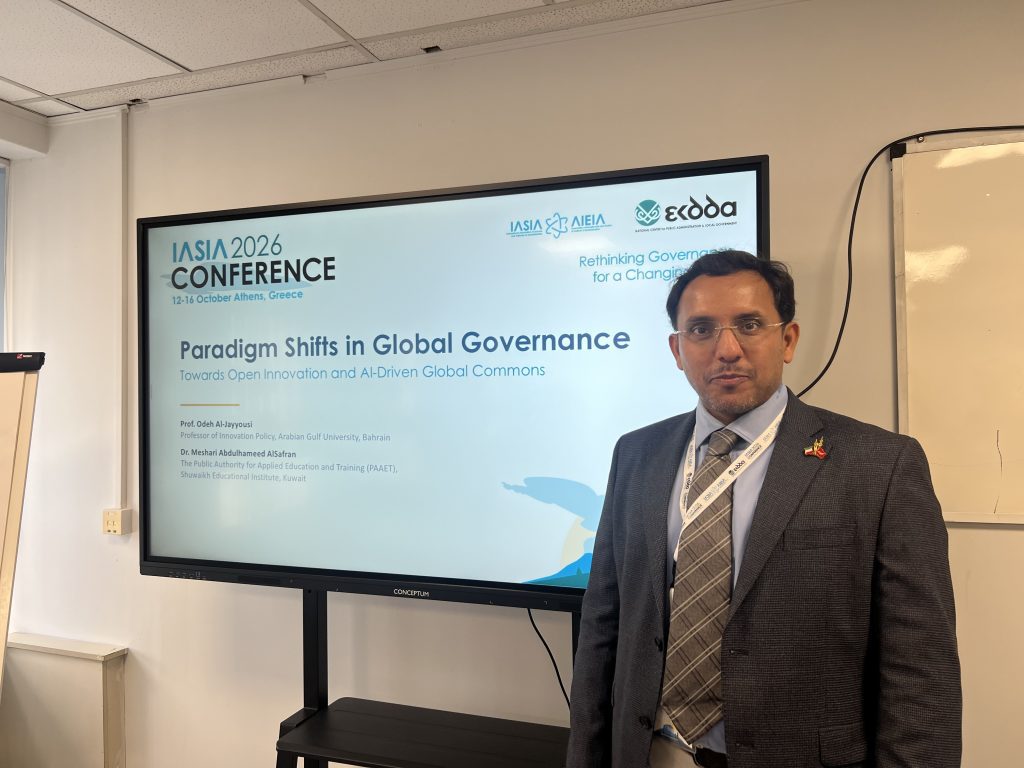
Dr. Al-Saffran said: “The real question is not the extent to which the government acquires artificial intelligence technologies, but rather the extent to which its institutions are capable of changing to utilize them properly. Our proposal to the Organization of Islamic Cooperation is that it become an AI-enabled innovation ecosystem, whose strength stems from connecting people, institutions, and technology around shared missions.”
The paper concluded by presenting seven research hypotheses for comparative studies among OIC member states, paving the way for further collaboration among public administration colleges and institutes in the region and beyond.