

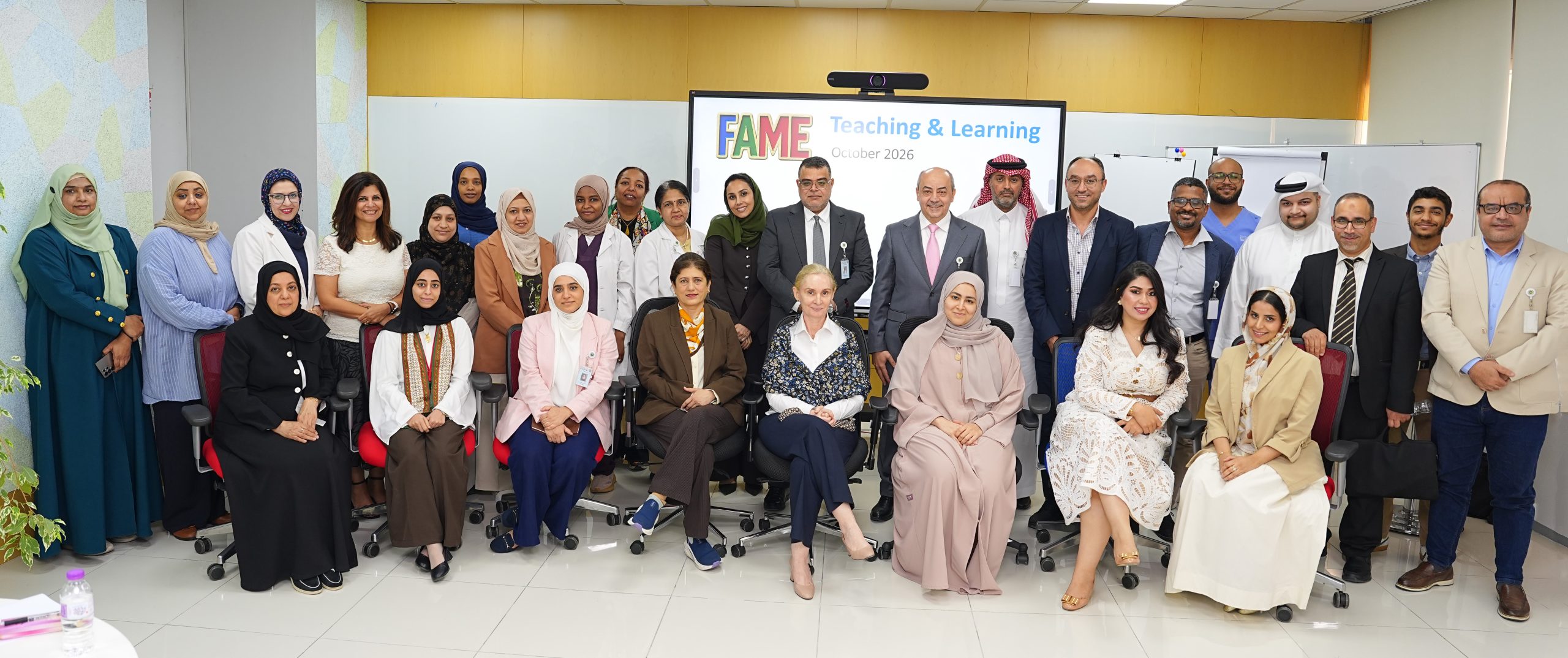
The Department of Medical Education at the College of Medicine, Arabian Gulf University, in collaboration with the University’s Consultancy and Training Center, organized a “Teaching and Learning” workshop as part of the Fundamental Skills in Medical Education (FAME) program, with the participation of 27 faculty members from inside and outside the university, representing various specialties. The workshop was held over four days as part of the university’s efforts to develop academic competencies and enhance teaching skills in the health sector.
The Fundamental Skills in Medical Education (FAME) program is a training initiative consisting of three main components: teaching and learning, course and curriculum design, and student assessment. It aims to equip academics with the knowledge and skills necessary to perform their educational roles effectively. It is delivered in English under the supervision of experts specializing in medical education at the university and combines scientific content with practical and interactive training. The National Health Regulatory Authority has accredited the program for 38 training hours covering its three main areas.
Dr. Mohamed Mustafa Al-Iraqi, Head of the Department of Medical Education, opened the workshop by welcoming the participants and emphasizing the importance of developing the academic competencies of healthcare professionals who are responsible for education, training, and health supervision. The training was co-led by Professor Hani Salem Atwa, Professor of Medical Education, Dr. Arshana Prabhu Kumar, Associate Professor in the Department of Medical Education, and Dr. Reem Jassim Al-Ansari, Assistant Professor in the department and Director of the University’s Simulation and Medical Skills Center.
The first workshop, dedicated to teaching and learning, covered basic learning theories and their applications, lecture design, problem-based learning facilitation skills, instructional design models, and session planning. It also covered flipped classroom strategies, the design of guided self-learning activities, interdisciplinary learning in the health sector, and microteaching activities.
The practical component included the design of comprehensive task-based learning activities using effective models of complex learning, along with simulations and role-playing. Participants practiced providing feedback to learners facing difficulties through scenarios drawn from the workplace, thereby linking theory to academic practice at universities and training centers.
Participant evaluations showed satisfaction levels ranging from 90% to 95% across various topics. They praised the richness of the scientific content, the diversity of the sessions, and the opportunities provided to exchange experiences and discuss best practices in teaching and learning as outlined in the scientific literature. Participants also discussed the challenges that may arise in applying these practices in medical education and ways to overcome them.