

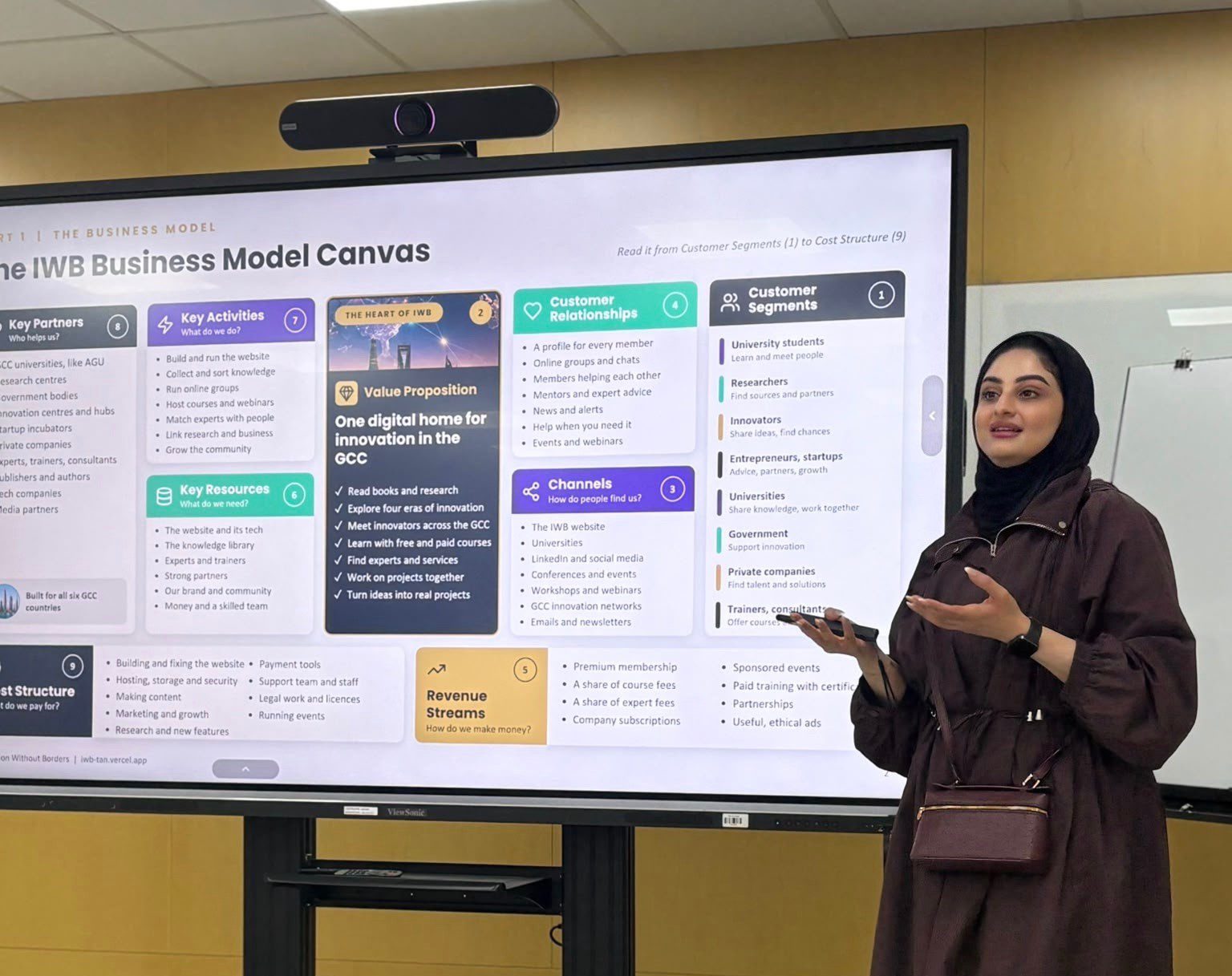
Students in the Ph.D. program in Innovation Management at Arabian Gulf University have launched the “Innovation Without Borders” initiative, a bilingual digital platform, Arabic and English, aimed at building an integrated Gulf-wide ecosystem that brings together researchers, students, experts, entrepreneurs, and innovators, and links academic knowledge to the needs of the business sector and society. This step reflects the university’s commitment to strengthening the knowledge economy and fostering a culture of innovation and entrepreneurship in the Gulf Cooperation Council (GCC) countries.
The initiative responds to the need for a unified digital space that helps reduce the fragmentation of knowledge and innovative resources among universities, research centers, government agencies, and private-sector institutions, and facilitates the exchange of expertise and the building of partnerships, thereby enhancing opportunities to transform research outputs and promising ideas into practical solutions and scalable entrepreneurial projects.
Ph.D. student Zainab Akbar outlined the platform’s vision and objectives, describing it as a Gulf hub for knowledge and innovation that facilitates communication and collaboration among various stakeholders in the innovation ecosystem across the GCC countries. She also outlined the stages of the platform’s development, from preparing the business model and designing the website to formulating the strategic plan and defining the phases for launch and expansion of the platform’s reach.
“Innovation Without Borders” comprises eight main sections within a unified account: the “Knowledge Library” for accessing books, journals, and academic theses; the “Innovation Community” for exchanging ideas and experiences; the “Innovation Academy” for training programs and workshops; “Expert Services” to connect consultants with organizations and individuals; “Innovation Challenges,” which allows entities to post their challenges and attract innovative solutions; the “Gulf Innovation Center,” which connects incubators, startups, and events across GCC countries; and the “Innovation Passport”—a digital portfolio documenting an innovator’s achievements, skills, and certifications—as well as the “History of Innovation,” which traces the milestones of human creativity from the Arab Golden Age to the horizons of the digital future.
The platform provides students and researchers with opportunities to learn, network with experts and mentors, and participate in real-world challenges, as well as to form research and professional teams and build portfolios of achievements that enhance their readiness to collaborate with institutions and the business sector, as part of a journey that begins with learning and knowledge sharing, and extends to developing ideas, collaborating, and launching startups.
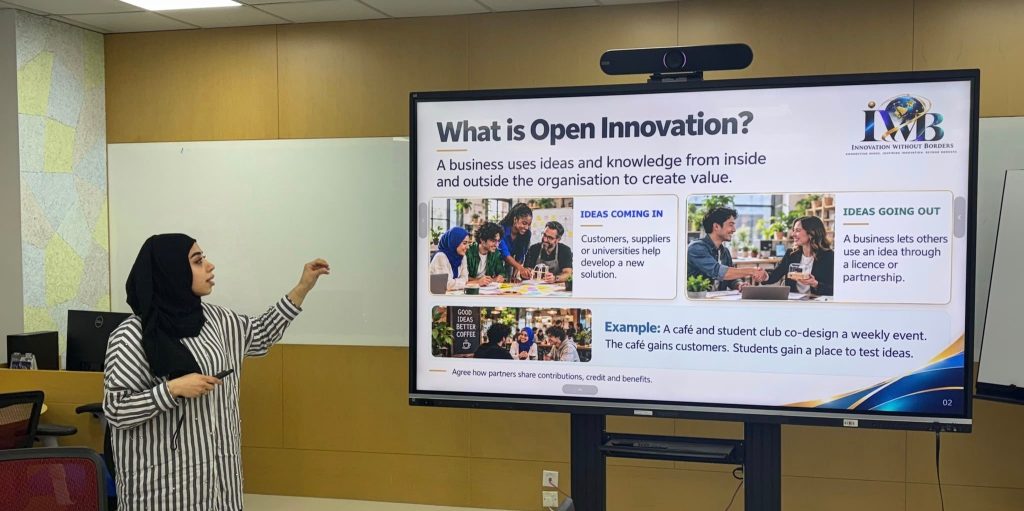
To link the initiative to practical application, Batoul Mubarak, a Ph.D. student in innovation, led an interactive workshop titled “Establishing a Small Innovative Project: Open Innovation and the Business Model,” which addressed the concept of open innovation—based on leveraging knowledge and expertise from both within and outside the organization to develop solutions and create value—and how to apply the nine elements of the business model to design projects and test their chances of success and sustainability.
The workshop focused on a practical methodology that begins with identifying a real problem faced by the customer, then developing a solution and designing an appropriate business model, testing the idea through a pilot experiment with real users, and analyzing the results to inform the project’s development.
The workshop included a group exercise titled “The Five-Group Challenge,” during which students worked in five groups to devise startup projects and build business models for them. These included a digital book club, an innovation café, an innovation clinic to support small and medium-sized enterprises, a recycling studio, and a skills-sharing initiative. Each group identified the problem their project aimed to address, the target audience, the proposed solution, partners, and potential revenue streams.
The challenge adopted an intensive, hands-on framework that utilized the Six Thinking Hats methodology to discuss ideas, build business models, and prepare pilot experiments, before the groups presented their projects in brief pitches addressing the problem, target audience, solution, revenue streams, potential partners, and expected social impact.
The practical applications underscored that entrepreneurial ideas remain hypotheses that need to be tested and validated before scaling up their implementation, through pilot experiments and measurable indicators that help assess their feasibility and refine them, thereby enhancing students’ ability to move from generating an idea to testing it and transforming it into a viable model.
The “Innovation Without Borders” initiative embodies the Arabian Gulf University’s commitment to linking academic knowledge with practical application and to preparing researchers and innovators capable of developing, testing, and transforming ideas into valuable solutions and projects. It also opens up broader horizons for collaboration with Gulf universities, research centers, business incubators, and the public and private sectors, thereby strengthening the innovation and entrepreneurship ecosystem and contributing to the knowledge economy in the Arab Gulf states.