
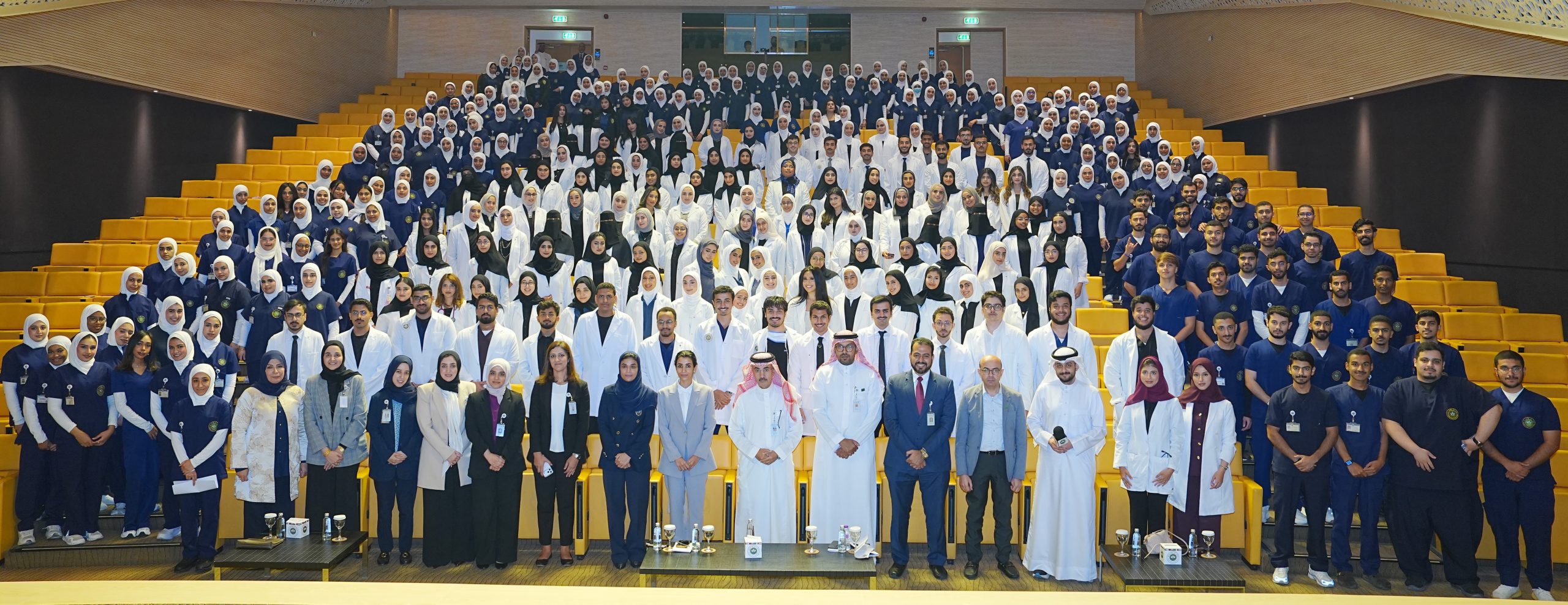
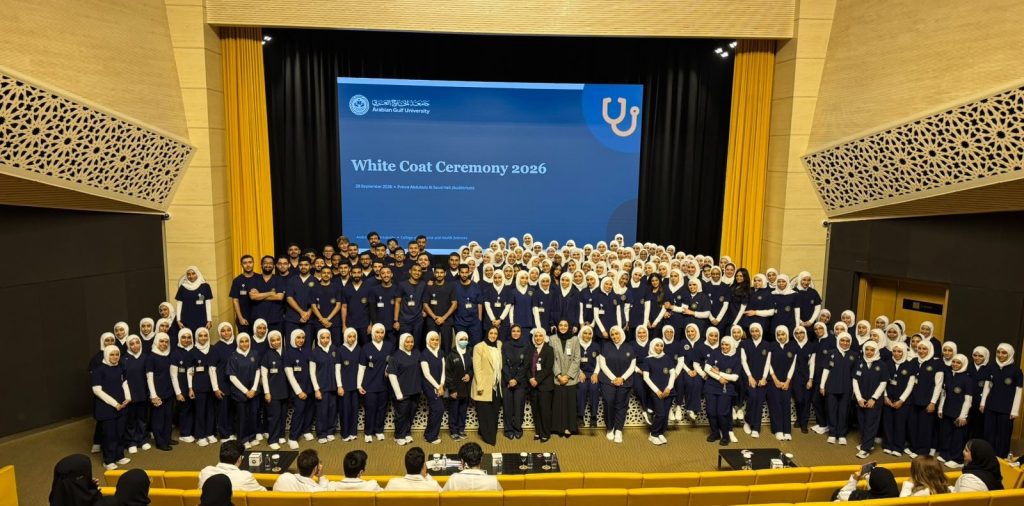
Arabian Gulf University organized a white coat ceremony for students at the College of Medicine and Health Sciences in the Prince Abdulaziz Al Saud Hall at the Princess Al-Jawhara Al-Ibrahim Center for Molecular Medicine, Genetics, and Genetic Diseases, to celebrate the students' achievement of an important milestone in their academic journey and their readiness to transition to the clinical training phase. There were 203 students in the Doctor of Medicine program and 202 students in the Bachelor of Science in Nursing program, all of whom are nationals of Gulf Cooperation Council (GCC) countries.
In a speech delivered during the ceremony, His Excellency the University President, Dr. Saad bin Saud Al-Fahaid, expressed his pride in the students of the Colleges of Medicine and Nursing reaching this exceptional milestone in their academic journey, saying: “Today you stand on the threshold of a new phase, as you transition to clinical training—where the theoretical knowledge you have acquired over the years of study meets the reality of practical application—to begin discovering the deeper meaning of the medical and nursing professions, when knowledge becomes healing, skill alleviates the patient’s suffering, and your presence brings comfort to those who need it”. He emphasized that medicine and nursing are among the noblest and most honorable professions due to their direct connection to human life and health, and the values of compassion, care, and selfless giving upon which they are founded.
His Excellency added while addressing the students: “What you have achieved is the result of sustained effort; you would not have reached this point without the knowledge and guidance provided by your professors and advisors, and without the support and encouragement of your families,” urging the students to maintain their passion for knowledge and to keep pace with the continuous developments in the fields of medicine and nursing.
For his part, the Dean of the College of Medicine and Health Sciences, Prof. Dr. Mohamed Saleh Madadin, explained in his speech during the ceremony: “The white coat worn by medical and nursing students today is not merely a symbol of the transition to clinical training; rather, it is a symbol of trust, responsibility, and humanity,” emphasizing that this stage moves students from the lecture hall to the hospital, and from textbooks to patients, and from case-based training to interacting with the patient as a person. He urged the students to learn—in addition to diagnosing and treating disease—how to care for the person living with that disease.
The dean emphasized the importance of students combining knowledge, skill, and humanity, and working as part of a unified healthcare team, noting that patients need a cohesive team that shares knowledge, respects the roles of its members, communicates effectively, and places the patient’s best interests and safety at the forefront of every decision. He also urged students not to be afraid to learn, to ask questions, to listen, to admit when they do not know something, to seek help, and to learn from patients, doctors, nurses, and all members of the healthcare team.
He also expressed his thanks and appreciation to the faculty members, clinical instructors, supervisors, and staff at hospitals and health facilities for their role in training students and contributing to the preparation of the next generation of healthcare providers. He concluded his remarks by wishing the students a clinical journey rich in learning, experience, and humanity, urging them to wear the white coat with pride and a sense of responsibility, and to be a source of healing for patients, relief from their pain, and service to their communities.
The ceremony included an oath-taking ceremony led by Dr. Abdullah Ismail Mohammed, Associate Dean for Clinical Affairs at the College of Medicine and Health Sciences, marking the beginning of a new phase in the students’ educational journey—one focused on clinical training and practice, as well as the responsibilities and ethical and humanitarian values inherent in the medical profession. Dr. Abdullah then delivered a lecture titled “Beyond the White Coat: Ethics, Professionalism, and Digital Identity,” which served as an important educational and guiding moment that shaped the true character of tomorrow’s doctors and nurses. In his lecture, he emphasized that adherence to the medical oath does not end upon leaving the ceremony hall; rather, it is an ongoing commitment that accompanies healthcare practitioners in medical wards, classrooms, and across virtual communication platforms.
Dr. Abdullah outlined the four fundamental pillars of medical ethics: autonomy, confidentiality, beneficence, and non-maleficence, and absolute fairness in treating patients. He emphasized that ethics and professionalism are not merely final exams to be passed, but rather daily practices and habits rooted in responsibility, mutual respect, collaborative teamwork, and continuous learning to keep pace with the rapid developments of the digital age. The lecture also addressed aspects that go beyond the symbolic significance of the white coat, exploring concepts of ethics and professionalism, as well as the digital presence of students and physicians, and the responsibilities imposed by the digital environment in building and maintaining professional identity.
The white coat ceremony serves as an occasion that combines celebrating the students with reminding them of the responsibilities inherent in the medical profession; the white coat is not merely a professional uniform but is associated in the medical community with the values of trust, commitment, ethics, and service to humanity.