

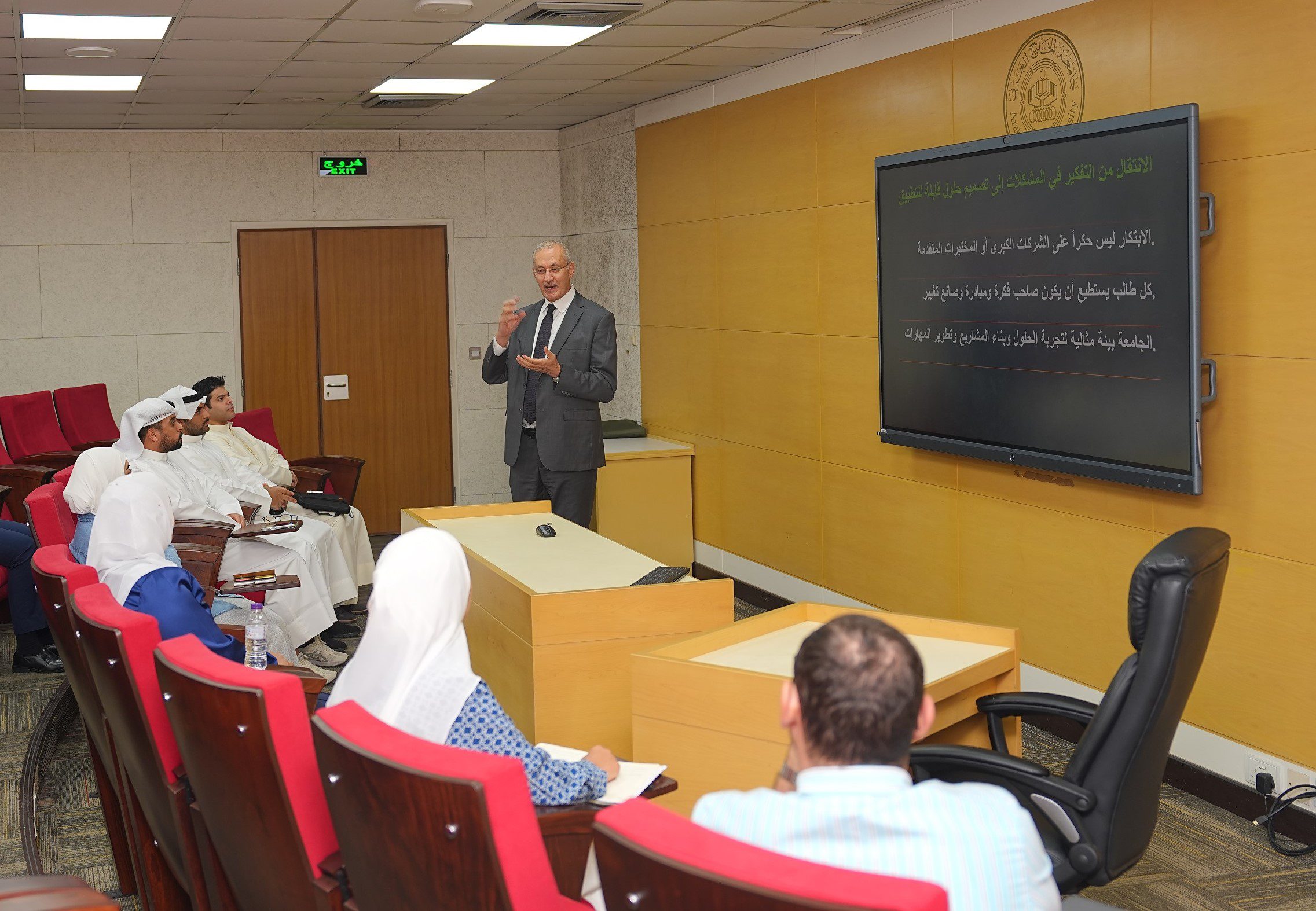
The Department of Business Administration and the Innovation Management Program at Arabian Gulf University organized an interactive lecture on social innovation and entrepreneurship as part of the activities of the Shaikh Isa bin Salman Al Khalifa Chair in Technology Management.
The lecture was presented by Prof. Dr. Ouda Al-Jaiyousi, Professor of Innovation Policy at the College of Education, Administrative and Technical Sciences, to a diverse audience of academics, students, and alumni. The event was held as part of the university’s strategic initiatives aimed at fostering a culture of innovation, strengthening its institutional environment, and developing initiatives with a social impact.
During the lecture, Dr. Al-Jaiyousi reviewed methodologies for social innovation and social entrepreneurship, highlighting the conditions for their success, the resources needed to implement them in universities, and their role in developing innovative solutions to societal challenges. He also addressed the importance of strengthening the role of academic institutions in generating knowledge and applying it to develop initiatives and practices that achieve a sustainable developmental impact.
He emphasized the importance of embedding the concepts of social innovation and social entrepreneurship in academic institutions, noting that “social innovation goes beyond generating new ideas to developing practical and sustainable solutions to societal challenges, while universities represent a pivotal environment for incubating these solutions through knowledge, scientific research, and effective partnerships.” He added that fostering a stimulating university environment, providing the necessary resources, and promoting a culture of initiative are essential elements for enabling students and researchers to transform their ideas into projects with tangible impact.
The lecture included a presentation on winning innovative initiatives from the university’s hackathon, delivered by Dr. Mai Sater, General Supervisor of Academic Chairs at Arabian Gulf University, and Professor Hussein Al-Hafnawi from the College of Medicine, who serves as coordinator at the Clinical Research Center. They highlighted the most notable innovative ideas and concepts behind these initiatives and the potential they demonstrate for leveraging creativity and collaborative work to develop practical solutions to health and societal challenges.
For her part, Dr. May Sater emphasized the importance of university hackathons in fostering creative thinking and promoting teamwork, noting that they “give participating students and teams the opportunity to move from the idea-generation stage to designing initiatives that address real-world needs, while also enhancing their skills in collaboration, solution-oriented thinking, and solution development.”
She added that the presentation of the winning initiatives provides opportunities to exchange experiences and highlight the potential of innovation in developing solutions, particularly in the health and community sectors.
In a related context, Professor Fairouz Al-Dhamour, Head of the Innovation Management Program and Professor of Management Information Systems, emphasized that the Ph.D. program in Innovation Management embodies Arabian Gulf University’s commitment to building leadership capacity and fostering innovation across various sectors. She explained that “investing in the development of leaders capable of managing innovation is a crucial pillar for institutional development and performance improvement, as well as for linking academic knowledge to practical application and the needs of society.”
She noted that the program, established in 2016, contributes to preparing and training leaders and specialized professionals in the education, health, and business administration sectors, thereby enhancing institutions’ ability to leverage innovation in improving their performance and adapting to change, and supporting their contribution to achieving the Sustainable Development Goals.
For her part, Dr. Afaf Bugawi, supervisor of the Shaikh Isa bin Salman Al Khalifa Chair in Technology Management, explained that the Chair’s activities are part of the university’s strategic vision to strengthen the role of scientific research and innovation in supporting digital transformation and technological advancement, noting that the Chair serves as an academic platform dedicated to exploring innovative solutions, developing human capital, and strengthening national and international partnerships, thereby contributing to a tangible impact in the field of technology management. She also emphasized the importance of the scientific activities organized by the Chair in enriching dialogue and the exchange of expertise, as well as in fostering a culture of innovation and entrepreneurship among students, graduates, and practitioners in the public and private sectors.
This lecture underscores the importance of integrating academic education with practical application, and the need to provide a university environment that fosters creative thinking and social entrepreneurship, thereby enabling students and graduates to transform their ideas into innovative initiatives that address the needs of society and contribute to finding sustainable solutions to development challenges.