

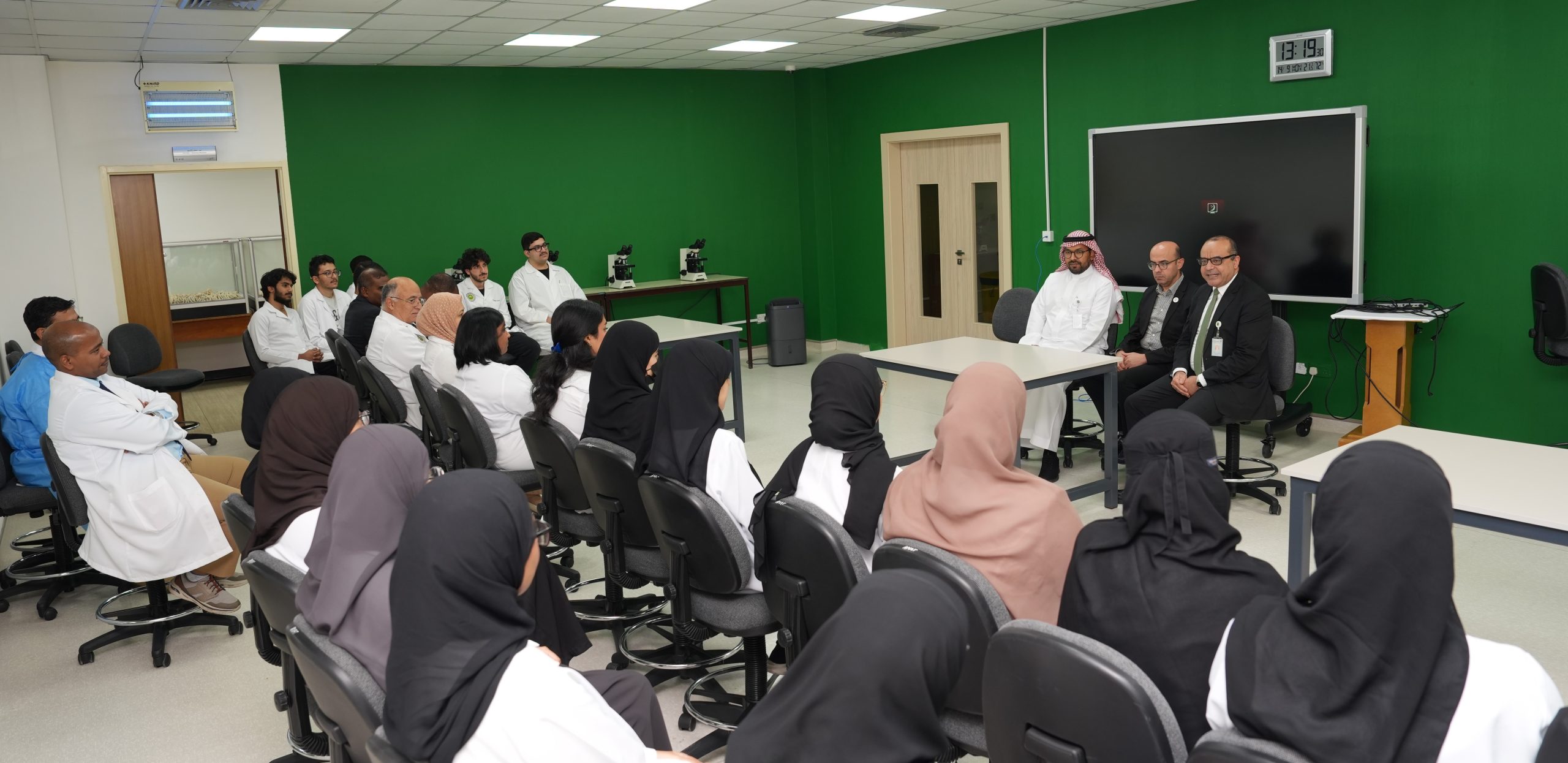
The fourth training session organized by the “Surgical Anatomy Club”—affiliated with the Department of Anatomy at the College of Medicine and Health Sciences—has commenced at Arabian Gulf University, in the presence of the Dean of the College of Medicine and Health Sciences Prof. Dr. Mohamed Madadin and his Vice Dean Yaseen Taim. 20 fourth-year students in the Doctor of Medicine program, who are interested in surgical and anatomical specialties, are participating in this four-week hands-on training program and concludes on October 8.
The course, titled “Lower Limb Anatomy Course,” aims to enhance students’ practical experience in the field of anatomy by providing them with the opportunity to gain hands-on training in anatomical tools, techniques, and skills, and to link theoretical anatomical knowledge with practical application, thereby deepening their understanding of the human body’s structure and its relationship to surgical practice.
The course is taught by Dr. Naji Mahmoud Ahmed Bakheet, a specialist in anatomy, and Dr. Mohamed Ali Younis Khan, a specialist in anatomy, under the supervision of the head of the Department of Anatomy, Prof. Dr. Wael Amin Nasr al-Din, with the participation of a select group of faculty members from the department. Students receive specialized practical training in lower limb anatomy within an academic learning environment that focuses on skill development and the enhancement of anatomical and surgical reasoning.
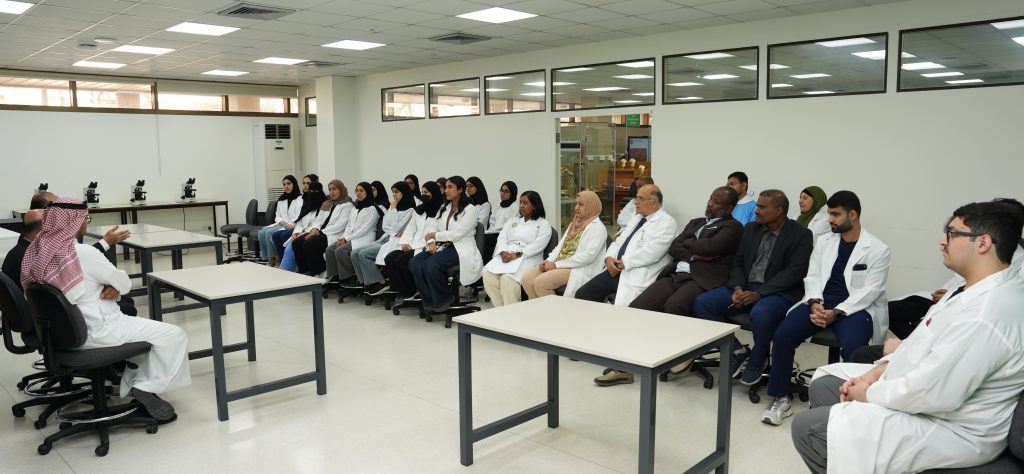
Prof. Dr. Wael Amin Nasr al-Din expressed his sincere thanks and gratitude to the Dean of the College of Medicine and Health Sciences, Prof. Dr. Mohamed Saleh Madadin, for his ongoing support and assistance, which played a significant role in organizing and hosting the course. He emphasized that “the Surgical Anatomy Club represents an important educational experience that goes beyond the boundaries of theoretical knowledge, as it gives students the opportunity to engage directly with anatomy and acquire practical skills that help them understand anatomical and surgical details with greater depth and precision,” noting that this experience helps better prepare students for clinical stages and their professional future, particularly those interested in surgical fields.
He added that “hands-on training in anatomy enhances students’ ability to connect anatomical structure with function and medical practice and provides them with a more solid foundation for understanding surgical procedures and managing clinical cases,” expressing his hope that the “Surgical Anatomy Club” will continue to play its role in providing high-quality educational opportunities for students and fostering their passion for anatomy and surgical sciences.