

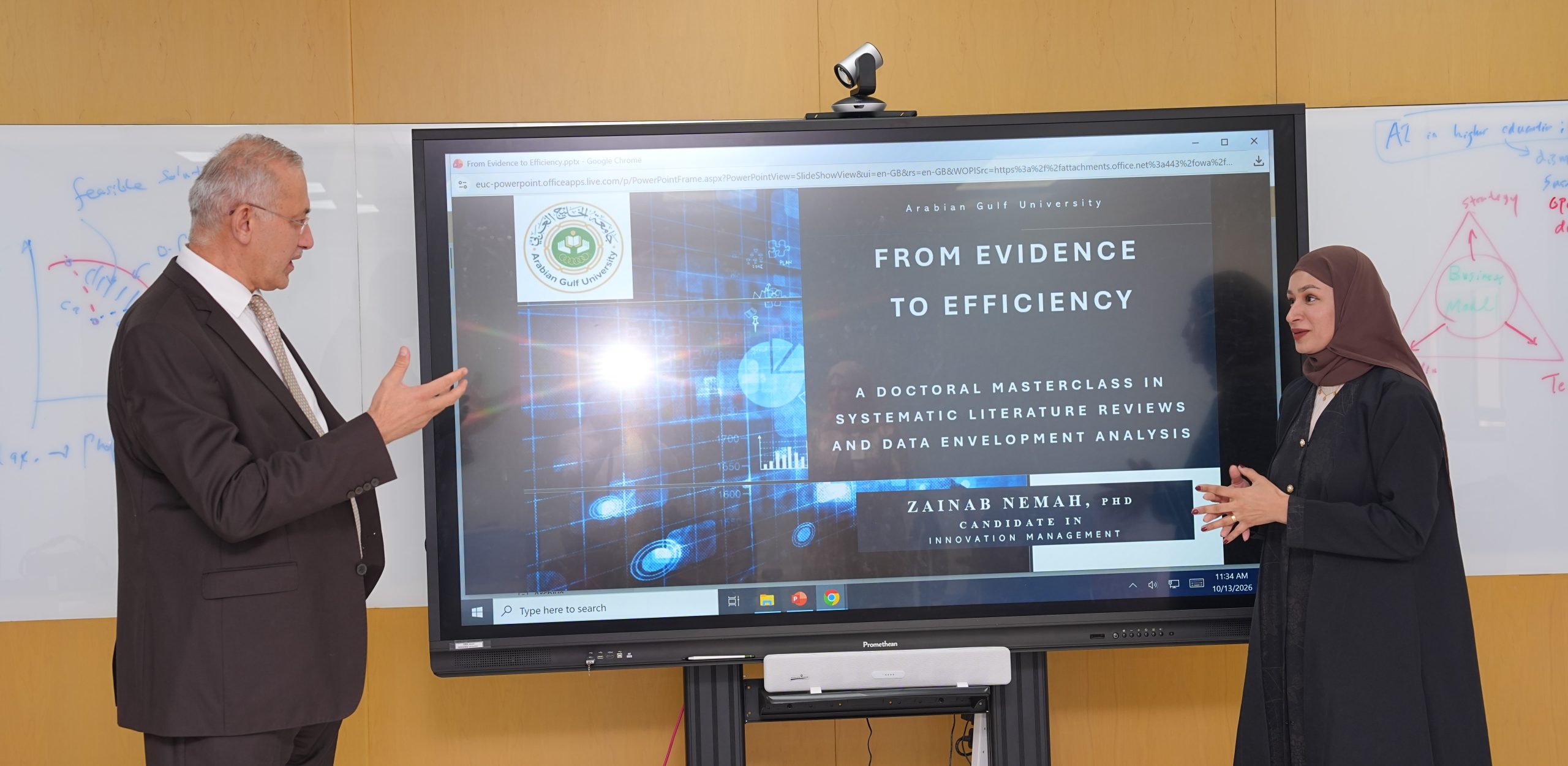
Zainab Hussain Nima, a doctoral student and researcher in the field of innovation management at the College of Education, Administrative and Technical Sciences at Arabian Gulf University, delivered a lecture titled “From Evidence to Efficiency: A Systematic Literature Review and Data Envelopment Analysis,” in which she reviewed scientific research methodologies and ways to apply them in developing innovative frameworks for evaluating university performance and measuring their efficiency. This lecture was part of the Department of Innovation and Technology Management’s efforts to foster a culture of innovation and advance research practices in higher education.
During the lecture, the researcher reviewed a methodology for measuring innovation efficiency in higher education institutions in the Gulf Cooperation Council (GCC) countries using data envelopment analysis. She explained how this methodology was applied in a case study to measure university efficiency and analyze their performance according to a set of dimensions and indicators, including sustainability, leading to the development of an innovative framework that contributes to evaluating university performance and understanding their levels of efficiency more comprehensively.
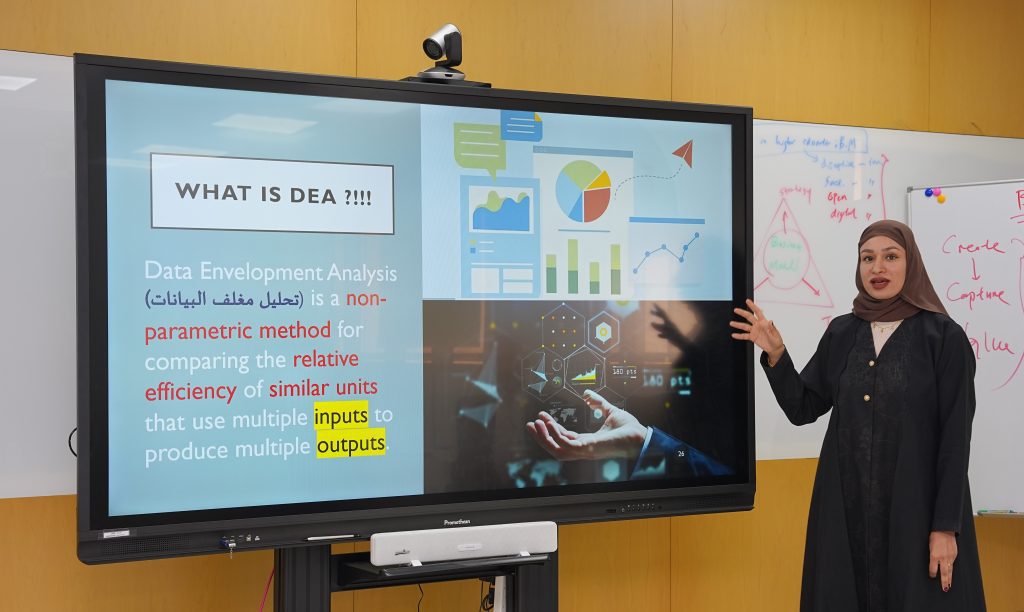
She provided a detailed explanation of the systematic review of the scientific literature, addressing the steps of structured research in previous studies, as well as the mechanisms for collecting, analyzing, and classifying the literature, leading to the identification of knowledge gaps that serve as a starting point for developing new research questions and building studies based on scientific evidence.
At the same time, she presented advanced research concepts and methodologies, thereby facilitating an understanding of quantitative tools and scientific review methods, and highlighting their importance in supporting scientific research and developing performance measurement and innovation practices in higher education institutions.
This lecture is part of an effort to strengthen research capabilities, disseminate methodological knowledge, and encourage the use of scientific evidence in developing the higher education system—thereby supporting innovation and sustainability and contributing to the creation of more effective and comprehensive evaluation frameworks for universities in the Gulf Cooperation Council (GCC) countries.
The current cohort of innovation students at Arabian Gulf University includes a group of leaders and professionals from various GCC countries, representing a number of vital sectors, foremost among them the education sector. This diversity of professional expertise and experience fosters the exchange of knowledge and insights among participants and supports the application of innovation concepts and practices in institutional development and performance improvement.