by ashokaib | Nov 4, 2025 | Uncategorized
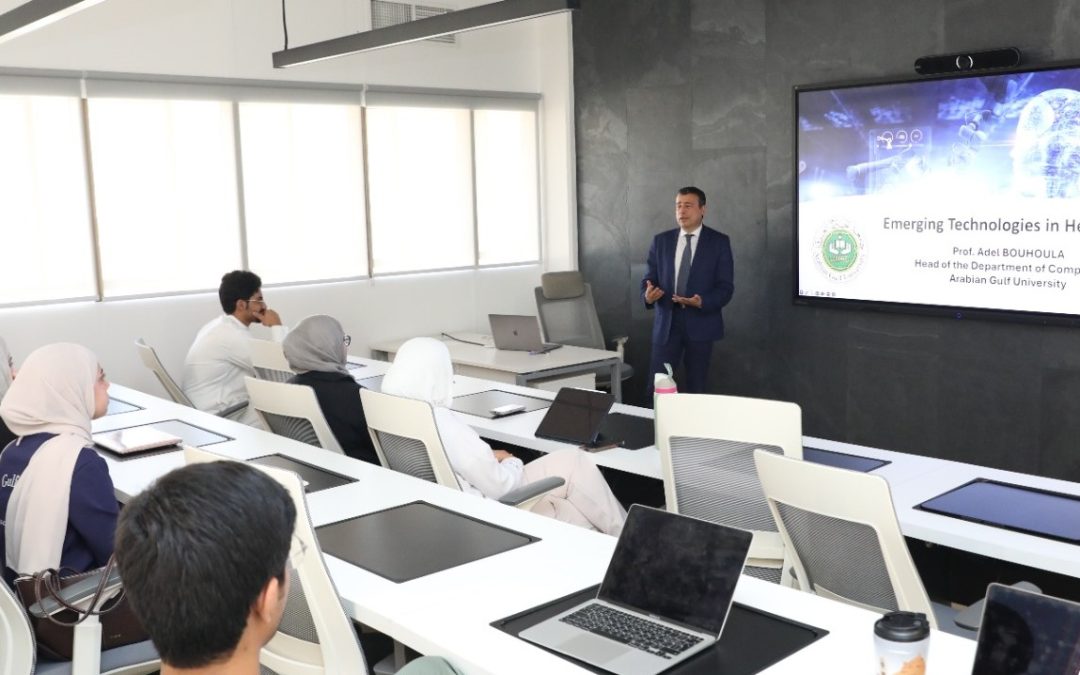
For the second consecutive year, the College of Medicine and Health Sciences at Arabian Gulf University (AGU) organised a two-day workshop titled "Emerging Technologies in Healthcare." The workshop was led by Prof Adel Bouhoula, Head of the IT Department at the College of Education, Technical and Administrative Sciences. Prof Bouhoula showcased the latest technological advancements, aiming to enhance students' skills in digital medicine.
The event targeted sixth-year students from the College of Medicine and Health Sciences, focusing on providing a fundamental understanding of prominent modern technologies transforming global healthcare. Topics included AI in medical diagnosis, blockchain technology for secure medical data management, the Internet of Things for remote health monitoring, and quantum technologies' role in accelerating drug discovery.
The workshop included advanced practical activities where students learned the basics of Python programming and its applications in healthcare. They received hands-on training using deep learning techniques to analyse X-ray images. Furthermore, AI models were trained on real datasets to differentiate between viral pneumonia, bacterial pneumonia, and benign cases. This experience demonstrated how modern technologies can support and improve diagnostic accuracy, paving the way for the development of innovative digital solutions in healthcare.
Dean of the College, Prof Abdelhalim Deifalla, stressed the significance of the workshop, stating, "This workshop reflects the college’s commitment to preparing future doctors capable of harnessing modern technologies to serve humanity and improve healthcare quality. Mastery and application of digital tools is now an essential aspect of contemporary medical practice."
For his part, Prof Adel Bouhoula, the workshop coordinator and lecturer, explained that the event aimed to bridge the worlds of medicine and technology, commenting, "The workshop sought to demonstrate that modern technologies are not as complex as they seem. They are tools whose fundamentals are accessible and can be easily applied by medical professionals to enhance diagnostics, treatment efficiency, and secure patient data, thereby laying a solid foundation for the future of healthcare."
He also affirmed that students' active engagement indicates a rising awareness of the importance of integrating technology into medical practice. He noted that this generation possesses the enthusiasm and knowledge to lead the future of healthcare with digital literacy and an advanced scientific vision.
by ashokaib | Nov 2, 2025 | Uncategorized
His Excellency Dr Saad bin Saud Al Fuhaid, President of the Arabian Gulf University (AGU), will participate in the proceedings of the 10th Arab Forum on Renewable Energy, organised by the Arab Renewable Energy Commission (AREC) in collaboration with AGU, represented by the Shaikh Zayed bin Sultan Al Nahyan Chair for Environmental Sciences. The forum will be held on Monday (November 3, 2025) under the theme: “Towards the Launch of the Comprehensive Guide to Renewable Energy in the Arab World”.
The forum will bring together an elite group of ministers, officials, experts, and representatives of Arab and international institutions involved in the sustainable energy sector. The opening ceremony will feature keynote addresses by several prominent figures, including His Excellency Eng. Kamal bin Ahmed, President of the AREC and President of the Electricity and Water Authority in the Kingdom of Bahrain, His Excellency Dr.Saad bin Saud Al Fahaid, President of AGU, Eng. Mohamed Al Taani, Secretary-General of the AREC, His Excellency Eng. Aziz Rabbah from the Kingdom of Morocco; and Dr Mohamed Al Naqi from the State of Kuwait.
The opening session will also include the recognition of supporting entities and participating countries, followed by a comprehensive agenda featuring presentations from representatives of various Arab nations, including Algeria, Kuwait, Iraq, Libya, Yemen, and Mauritania. The second day will be dedicated to the presentation of official reports on the status of renewable energy in Arab countries, with contributions from Bahrain, Syria, Jordan, Morocco, Somalia, the UAE, Egypt, Palestine, Qatar, Saudi Arabia and Oman.
Additionally, the forum will include a series of public awareness sessions presenting research papers on “Health, Environment, and Renewable Energy” and “Green Education in the Arab World,” along with the fifth meeting of the Executive Office of the AREC.
On the third day, discussions on the Arab Renewable Energy Guide will continue through an extended dialogue session titled “Comprehensiveness of the Arab Renewable Energy Guide”, featuring the participation of representatives from Arab countries, experts and academics. The session aims to pave the way for the publication of a scientific and institutional reference that will strengthen Arab cooperation and lead towards a more sustainable future for the region.
by ashokaib | Nov 2, 2025 | Uncategorized
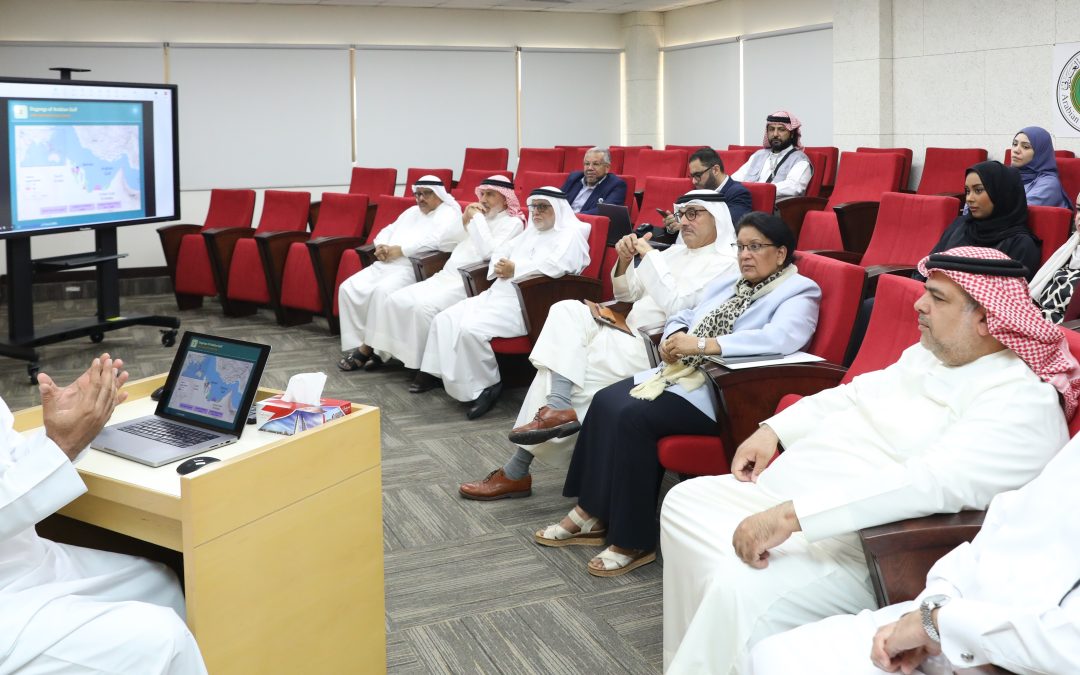
The Shaikh Hamad bin Khalifa Al Thani Chair for Geographic Information Systems, in collaboration with the Shaikh Zayed bin Sultan Al Nahyan Chair for Environmental Sciences, organised a scientific lecture hosted by the Environmental and Life Sciences Centre at the Arabian Gulf University (AGU) on Wednesday, titled “Mermaids of the Arabian Gulf: Dugongs, the Engineers of Seagrass Ecosystems”. The lecture was delivered by environmental researcher Dr Abdulqader Saeed Khamees.
Dr Khamees began with a captivating scientific introduction to dugongs, commonly known as “mermaids” or “sea cows”, highlighting their ecological significance and essential role in maintaining the balance of marine ecosystems across the Arabian Gulf as a key species in coastal environments.
He also presented the latest scientific findings on the strong interdependence between dugongs and seagrass habitats, noting that the Arabian Gulf is home to one of the world’s largest dugong populations, particularly around the Hawar Islands of the Kingdom of Bahrain.
The researcher discussed the environmental interactions between dugongs and their marine surroundings, as well as their encounters with fishing vessels and human activities, stressing that these gentle creatures face increasing threats such as the degradation of seagrass habitats, pollution and collisions with boats.
The lecture concluded with a series of scientific and practical recommendations to ensure the sustainability of this unique species and the preservation of the ecosystems upon which they depend.
In this context, His Excellency. Dr. Saad bin Saud Al Fahaid, President of AGU, affirmed the university’s ongoing commitment to supporting research initiatives that highlight the marine environment of the Arabian Gulf.
Commenting on the occasion, he stated: “These activities embody the scientific synergy between the Chairs established in honour of Their Highnesses, the leaders of the GCC states, and reflect AGU’s belief in investing in scientific knowledge to safeguard our Gulf environment and preserve its natural resources for future generations.”
He added that the scientific chairs represent a pioneering model in uniting research efforts among GCC institutions, emphasising the university’s dedication to strengthening collaboration in environmental, sustainable development and geo-intelligence studies.
This event comes as part of the ongoing activities and initiatives of the scientific chairs established in honour of GCC leaders at AGU, under the supervision of the University President, as part of continuous efforts to enhance applied scientific cooperation between the university, government and private institutions, and research bodies across the GCC. These efforts aim to strengthen connections, expand environmental knowledge and support research studies focused on the development and sustainability of natural resources in the Arabian Gulf..
by ashokaib | Nov 2, 2025 | Uncategorized
A team of students from the College of Medicine and Health Sciences at Arabian Gulf University (AGU) has achieved a scientific milestone with the publication of their research in BMC Primary Care, a global journal ranked in the first quartile (Q1) for scientific impact. The research, conducted by the students as part of the community-oriented research programme, addressed the barriers limiting women's adherence to early breast cancer screening in the State of Kuwait.
The student research team leader, Omar Al Failakawi, said: "In this study, we sought to understand the real reasons behind the low rates of breast cancer screening. The percentage of those who underwent screening within the past two years did not exceed 25.4%, while more than half of the participants (52.2%) had never undergone it, despite the vast majority being aware of the national screening programme."
He added: "Among the most prominent barriers leading to women's low adherence to regular screening were the fear of pain and physical discomfort, and a lack of knowledge regarding the correct timing and frequency of the screening. However, the most significant finding was that receiving a direct invitation from health authorities to undergo screening was linked to a notable increase in participation rates, which confirms that mere awareness of the programme's existence is not sufficient unless supported by practical steps that motivate and encourage women."
These findings highlight the need for more effective awareness campaigns, organised invitation and reminder systems, and professional consultations to reassure women. This would ensure an increase in early breast cancer detection rates and reduce its health and economic burden in Kuwait.
For his part, student researcher Hussain Alostad described the experience, saying: "This research journey was enriching on all levels. We gained practical skills in data analysis and direct communication with community members during the interviews we conducted at health centres. The Family and Community Medicine Department at AGU played a significant role in preparing and supporting us from day one. They helped teach us the fundamentals of scientific research and provided all the resources that contributed to this success. We extend our thanks to our research supervisors who guided and directed us throughout the project."
Alostad added: "After completing this research, we were given the opportunity to present its findings at the 13th Research Day at AGU, where, by the grace of Allah, we won third place. We also participated in the 29th Scientific Poster Conference at Kuwait University. The culmination of our efforts was publishing in a journal of this caliber, which makes my colleagues and me proud of these achievements and gives us strong motivation to continue our journey in scientific research."
The main research supervisor, Professor Dr Mohamed Hany Shehata, commented on the achievement, saying: "This accomplishment is a true embodiment of our university's philosophy of preparing future leaders in the health sector. The community-oriented research programme moves students from the lecture halls to the heart of the field, allowing them to learn by practice and engage with real-world health challenges. This direct interaction hones the student's character as a researcher and a leader and enables them to provide innovative, evidence-based solutions, which is reflected in this outstanding research."
He explained that reaching the level of publication in an indexed journal is not mandatory for our students, "but it requires passion, commitment, patience, and perseverance, which this research team has demonstrated with great competence, by the grace of Allah the Almighty."
Professor Shehata also praised the publication, noting that it reflects the quality of research training students receive at the university. He pointed out that student participation in internationally published scientific research contributes to preparing a generation of doctors capable of contributing to the advancement of medical knowledge at regional and international levels.
From their side, the research team affirmed that their goal for the study was to support national efforts to enhance health awareness and empower women to undergo regular screenings for early detection, thereby contributing to higher recovery rates and reduced complications.
It is noteworthy that the AGU encourages its students to engage in scientific research from the early stages of their studies. It provides a stimulating academic environment that helps hone research and scientific publishing skills in accordance with the highest international standards.
by ashokaib | Nov 2, 2025 | Uncategorized
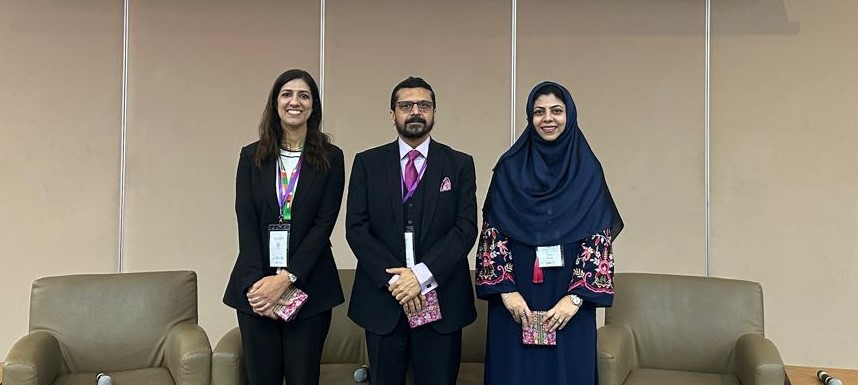
Academics from Arabian Gulf University (AGU) delivered two presentations that showcased the university's role in innovation in health education and cementing the quality and social accountability systems according to the highest international standards. This took place at the International Medical Education Conference (IMEC–ICME 2025), which was recently hosted by the International Medical University (IMU) in Malaysia.
Dr Mai Sater, Chairperson of the department of Medical Biochemistry at the College of Medicine and Health Sciences, gave the first scientific presentation, titled "AGU as a Regional Model for Stakeholder Engagement in Higher Education and Health Education."
The presentation highlighted the university's approach to building bridges between global educational frameworks, such as the World Federation for Medical Education (WFME) standards, and the real-world needs and regional job markets, all within a comprehensive vision that aligns with the GCC Vision 2030.
During the presentation, she stressed that stakeholder engagement transforms educational reforms from scattered efforts into an integrated system of trust and cooperation.
"AGU makes this participation an authentic part of its governance and institutional culture, not just a symbolic gesture, through an integrated governance system that includes the General Conference, the Board of Trustees, and the University Council. This ensures representation from decision-makers in government bodies, ministries, and industrial sectors alongside academics." She said.
Moreover, she showcased the Scientific Chairs programme at AGU, which received support from Gulf leaders such as Shaikh Zayed bin Sultan Al Nahyan, His Majesty King Hamad bin Isa Al Khalifa, and Sultan Qaboos bin Said. She described it as a model for converting regional investment into sustainable knowledge and research leadership, providing practical examples of the university's efforts in engaging various stakeholder groups.
She highlighted several initiatives, such as making students and faculty members partners in development through the "Quality Voices" initiative, which empowers students to participate in quality committees and curriculum development in accordance with WFME and NCAAA standards.
"Governments and employers are also made strategic partners, as the university works to align its programmes with Vision 2030 to ensure the alignment of outcomes with the needs of the Gulf job market, as demonstrated in the benchmarking project with the Royal College of Surgeons in Ireland - Medical University of Bahrain (RCSI)." She stated.
In the context of the initiatives, she noted the role of the community and patients as partners in social accountability by involving them in college councils and core committees, thereby strengthening the connection of health education to the real-world needs of the community.
She emphasised, "The globalisation of medical education cannot be imposed from the top down; it is built collaboratively with those who live and create the experience. We must build high-quality, high-trust educational systems."
Meanwhile, and during the conference, Dr Archana Prabu Kumar, Assistant Professor of Medical Education at AGU, presented the second research presentation, titled: "Validating the Effectiveness of Simulated Patient Training for Teaching and Assessing History-taking Skills among Medical Students in the Obstetrics and Gynecology Specialisation."
She explained that the research, which involved a multidisciplinary team from the departments of Medical Education, Obstetrics and Gynecology, Anatomy, Community Medicine, and the Clinical Skills and Simulation Centre, aims to develop a structured training programme for simulated patients that ensures realism, consistency, and educational quality in assessing students' clinical skills.
She said: "The power of simulation lies not only in realism, but in the ability to reflect and learn through practice and feedback in a safe environment. This project reflects AGU's firm commitment to evidence-based education, interdisciplinary collaboration, and continuous quality improvement in line with the standards of the World Federation for Medical Education (WFME) and the National Commission for Academic Accreditation and Assessment (NCAAA)."
AGU's participation in the IMEC–ICME 2025 conference embodies its unified vision towards high-quality health education based on partnership, innovation, and social accountability. This is in the context of strengthening its position as a regional beacon for collaboration and academic excellence, in preparation for hosting the next global event, the International Medical Education Conference (ICME 2027) in the capital, Manama, in partnership with Riphah International University (Pakistan).