by ashokaib | Aug 17, 2025 | Uncategorized
A delegation from the Gifted Education Program within the Special Education Department at the College of Education, Administrative and Technical Sciences at Arabian Gulf University (AGU) recently participated in the 26th World Council for Gifted and Talented Children World Conference (WCGTC 2025), held in Braga, Portugal. This biennial event brought together gifted education researchers and specialists from 35 countries to exchange experiences and review the latest scientific advancements in the field.
Led by Dr Ahmed Mohamed Alabbasi, Vice Dean of the College of Education, Administrative and Technical Sciences, and Head of the Special Education Department, the delegation included graduate students from the Gifted Education Program. The participants engaged in various practical and interactive workshops, allowing them to connect with international experts to acquire new skills and share the best practice, besides meeting other graduate students from various universities.
In recognition of his significant contributions to the field of gifted education, Dr Ahmed Alabbasi was honoured with the Emerging Scholar Award during the conference. He also participated as a keynote speaker in a panel discussion, sharing his expertise and research with an international audience of experts and researchers.
The delegation members expressed their gratitude to the university administration for providing this valuable opportunity. They highlighted the importance of such conferences in fostering scientific and cultural communication, keeping abreast with global trends, and advancing the education and care of gifted students.
This participation underscores AGU’s ongoing commitment to supporting students and academic staff, as well as strengthening its position as a leading institution in innovation and the development of gifted education programs, regionally and globally.
by ashokaib | Jul 10, 2025 | Uncategorized
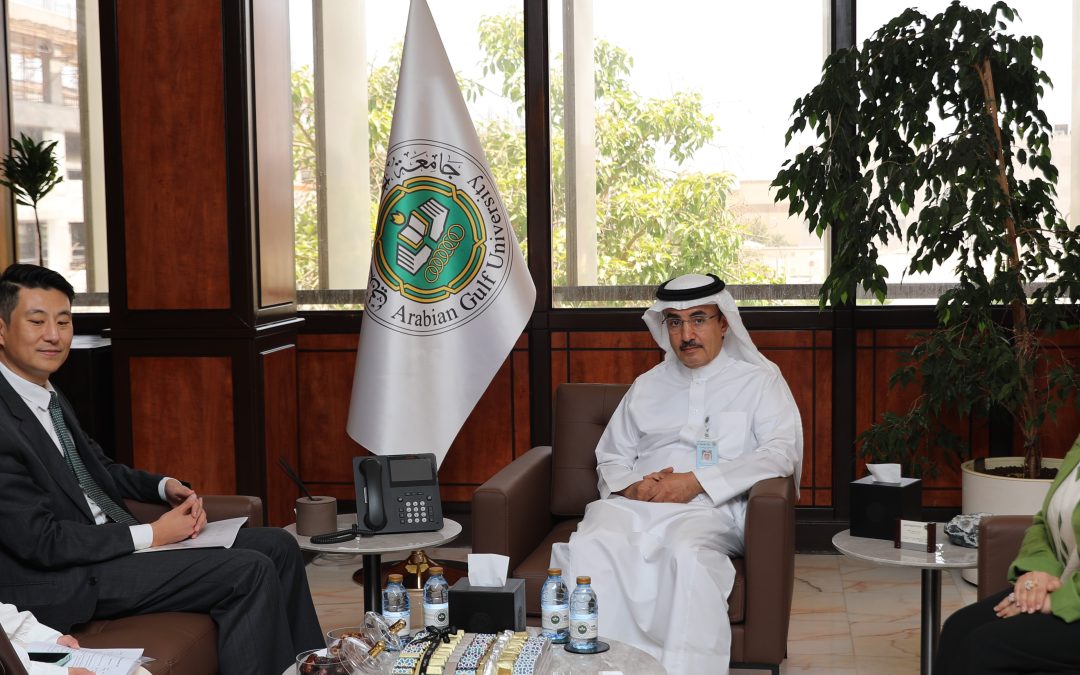
His Excellency Dr Saad bin Saud Al Fuhaid, President of the Arabian Gulf University (AGU), has recently met with Mr Jiang Li, Counsellor and Deputy Head of Mission at the Embassy of the People’s Republic of China to the Kingdom of Bahrain, accompanied by Embassy Attaché Ms Yi Xinyu, to explore avenues of collaboration in higher education, training and the application of artificial-intelligence technologies within the medical sector.
The meeting reviewed a range of topics of mutual interest, including the exchange of expertise, knowledge transfer and the organisation of official visits to leading AI-enabled hospitals in China, with a view to applying Chinese experience to the development of the university hospital at King Abdullah bin Abdulaziz Medical City in the Southern Governorate.
Discussions also covered potential cooperation in research, as well as the organisation of specialised training courses and workshops to bolster the skills of AGU’s academic and medical personnel.
On the occasion, Dr Al Fuhaid affirmed AGU’s commitment to building strategic partnerships across multiple sectors, particularly in innovation and medical technology, praising China’s significant advances in artificial intelligence and scientific research.
For his part, Mr Jiang Li expressed the Embassy’s interest in establishing a Chinese-language institute at AGU, supported by the Chinese Government, and noted the possibility of future educational and training programmes for university staff and students.
Also present at the reception was Dr Afaf Bugawa, Director of AGU’s Centre for Community Service, Consultancy, Training and Continuing Education
by ashokaib | Jul 10, 2025 | Uncategorized
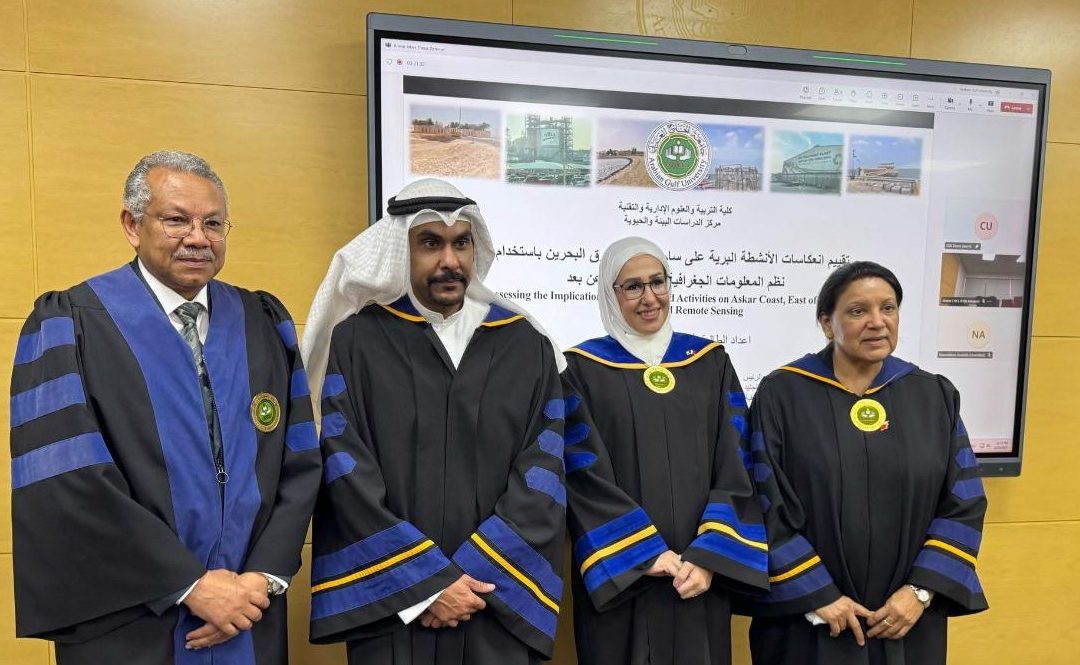
Ms. Anwar Jaber Al Aseemi, a researcher in the Department of Natural and Environmental Sciences, College of Education and Administrative and Technical Sciences at the Arabian Gulf University (AGU), has assessed the impact of land-based activities on Bahrain’s Askar coastline by employing geographic information systems (GIS) and remote-sensing techniques.
The study formed part of her doctoral thesis, supervised by Dr Sabah Al Jenaid (principal supervisor) and Dr Thamer Al Dawood (co-supervisor).
Using Sentinel-2 satellite imagery from 2015-2024, Ms. Al Aseemi analysed six spectral indices to produce more than 100 monthly maps detailing vegetation cover, soil aridity and built-up areas. Her hydrological modelling showed that the terrain is largely flat: nearly 40 per cent (approximately 5 km²) of the study area is level, with no significant elevations to influence surface-water flow. A further 23 per cent is almost flat, while 52 per cent has a gentle slope.
Built-up land expanded noticeably over the decade, rising from 9.7 per cent (1 km²) in 2015 to more than 16 per cent (about 2 km²) in 2024. Wetlands around the shoreline remained almost unchanged at 2.3 per cent (0.3 km²). Green vegetation is confined largely to gardens within residential plots, and the road network grew from 6.8 per cent (0.9 km²) to 10.5 per cent (1.4 km²) over the same period.
The spectral indices confirmed persistent aridity, a factor that heightens airborne dust and other pollutants. Analysis within the DPSIR framework indicated that escalating land-based activities have exerted continuous pressure over the past ten years, potentially increasing marine pollution along the coast.
The thesis recommends a clear action plan and overarching framework for sustainable management, in line with the Bahrain 2030 strategy, to mitigate the environmental impact of development projects on marine and coastal ecosystems.
by ashokaib | Jul 10, 2025 | Uncategorized
Dr Ahmed Malallah Al Ansari, Professor of Psychiatry at Arabian Gulf University (AGU) and Child and Adolescent Psychiatry Consultant, affirmed the importance of adapting classroom environments and teaching strategies to support children with attention deficit hyperactivity disorder (ADHD). During a workshop organised by the AGU Centre for Community Service, Consultation, Training, and Continuing Education titled "Classroom Treatment for Children with ADHD," he discussed the challenges faced by these children, including difficulties with concentration, organisation, impulse control, and maintaining focus over extended periods. He pointed that tailored classroom treatments are essential to promote their learning, behavioural, and social development.
Dr Al Ansari highlighted the importance of educating teachers and all concerned parties about ADHD to foster understanding and prevent misinterpretation of behaviours as misbehaviour. Building a positive relationship between teachers and students is fundamental for effective intervention.
He stated, "Creating a suitable classroom environment for students with ADHD involves minimising distractions, such as seating students away from windows or doors, and positioning them close to the teacher for better guidance and supervision." He also stressed the use of visual and auditory cues to facilitate smooth transitions between activities.
"Breaking down long tasks into shorter, interconnected steps and utilising visual schedules or picture cards to illustrate the daily routine can significantly help students with ADHD,” he added, highlighting the necessity of providing clear, step-by-step instructions along with repetition to ensure they fully understand expectations.
On time management, Dr Al Ansari noted, "Visual timers can enhance children's awareness of time, while short breaks during lengthy activities help maintain focus and energy." He stressed positive reinforcement, suggesting immediate rewards such as stars, stickers, or verbal praise to motivate desired behaviours, and the implementation of reinforcement schedules like star charts for consistency.
He advised, "Minor, harmless inappropriate behaviours can often be ignored, while clear, logical consequences should be applied without yelling or threats. A consistent and predictable routine can help children with ADHD feel secure and supported.”
In terms of social development, Dr. Al-Ansari encouraged fostering positive peer relationships through cooperative play and teaching conflict resolution skills. He also highlighted the importance of ongoing collaboration with families and mental health professionals, noting, "Regular meetings with parents and psychologists are crucial to monitor progress, and external interventions, whether pharmacological or behavioural, may be necessary depending on each child's needs."
The workshop saw the participation of over 60 attendees, including representatives from the Ministry of Education, community service personnel from the Ministry of Interior, rehabilitation centres, and members of the Bahrain ADHD Society. It reviewed foundational topics such as classroom management, involving families and senior management, effective use of reinforcers, and organising the school environment.
The goal was to enhance the skills of educators, rehabilitators, and school administrators working directly with children with ADHD, thereby improving their educational experiences and outcomes.
by ashokaib | Jul 9, 2025 | Uncategorized
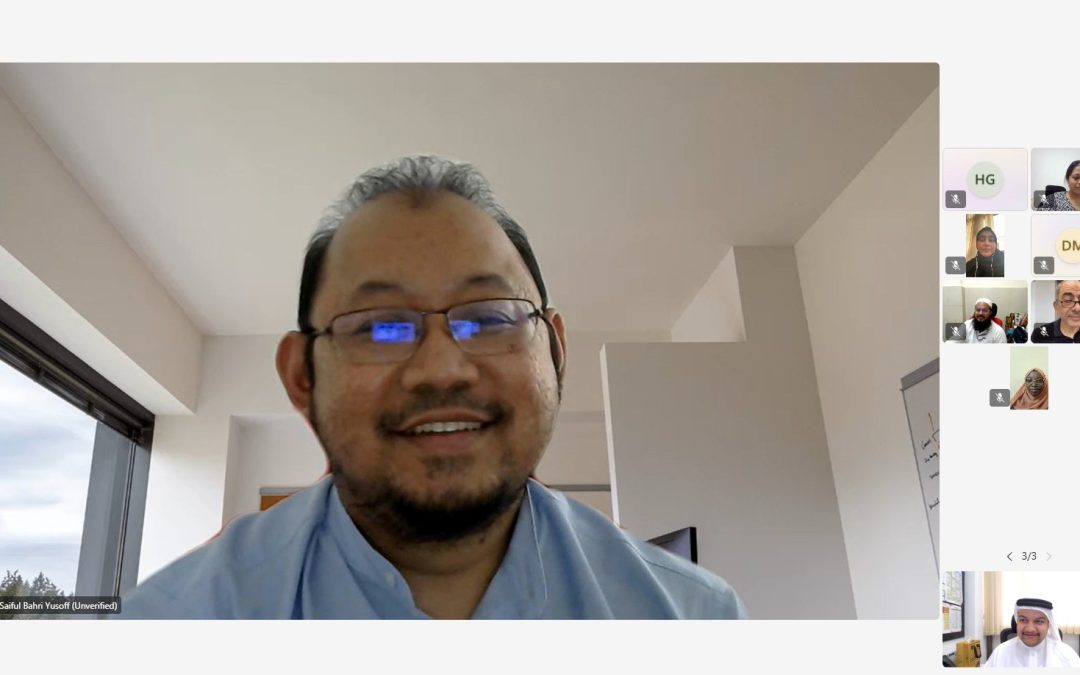
The World Health Organization (WHO) Collaborating Centre for the Development of Health Professionals’ Education, based at AGU’s College of Medicine and Health Sciences, has concluded a virtual workshop titled “Modern Assessment Methods in Health-Professions Education”.
The programme was organised in cooperation with the WHO Country Office and led by Prof. Muhamed Saiful Bahri, Professor of Medical Education at University of Putra Malaysia and a noted authority on curriculum development and contemporary assessment strategies.
The workshop was designed to strengthen the capacity of faculty members across the Middle East and North Africa to design, implement and evaluate evidence-based assessment tools that support student learning and competence attainment. It underlined the pivotal role of assessment in steering the educational process and ensuring the quality of medical education, particularly amid rapid advances in teaching strategies and the growing demand for transparency and academic accountability.
Participants were introduced to assessment practices recommended by global frameworks such as the World Federation for Medical Education (WFME) and Best Evidence Medical Education (BEME). Key themes included the principles underpinning modern assessment in the health professions, attributes of effective evaluation – validity, reliability, fairness and educational impact, integration of assessment into competency-based curricula, and the faculty role in securing robust and consistent application of assessment standards.
Prof. Saiful Bahri noted that the workshop forms part of a series of initiatives spearheaded by the Centre to advance health-professions education through continual innovation, regional and international collaboration, and the empowerment of academic staff.
Prof. Abdelhalim Deifalla, Dean of the College of Medicine and Health Sciences, emphasised that the programme aligns with the College’s ongoing efforts to enhance the quality of medical education and develop the skills of health-care professionals.
He underscored the College’s commitment to exchanging expertise with leading academic institutions and research centres worldwide to promote evidence-based education and improve the outcomes of health-care training programmes in the Gulf and Arab regions.
Targeting academics, health-care practitioners and medical-education specialists, the workshop provided an interactive platform to discuss global trends in academic evaluation, including the use of digital technologies, objective measurement tools and the adoption of internationally recognised best-practice standards.
Prof. Saiful Bahri currently serves as Editor-in-Chief of the Journal of Medical Education, President of the Malaysian Association of Medical and Health Sciences Education, Special Adviser to the Executive Director of the ASEAN University Network (AUN), and AUN Regional Director for East Asia.